
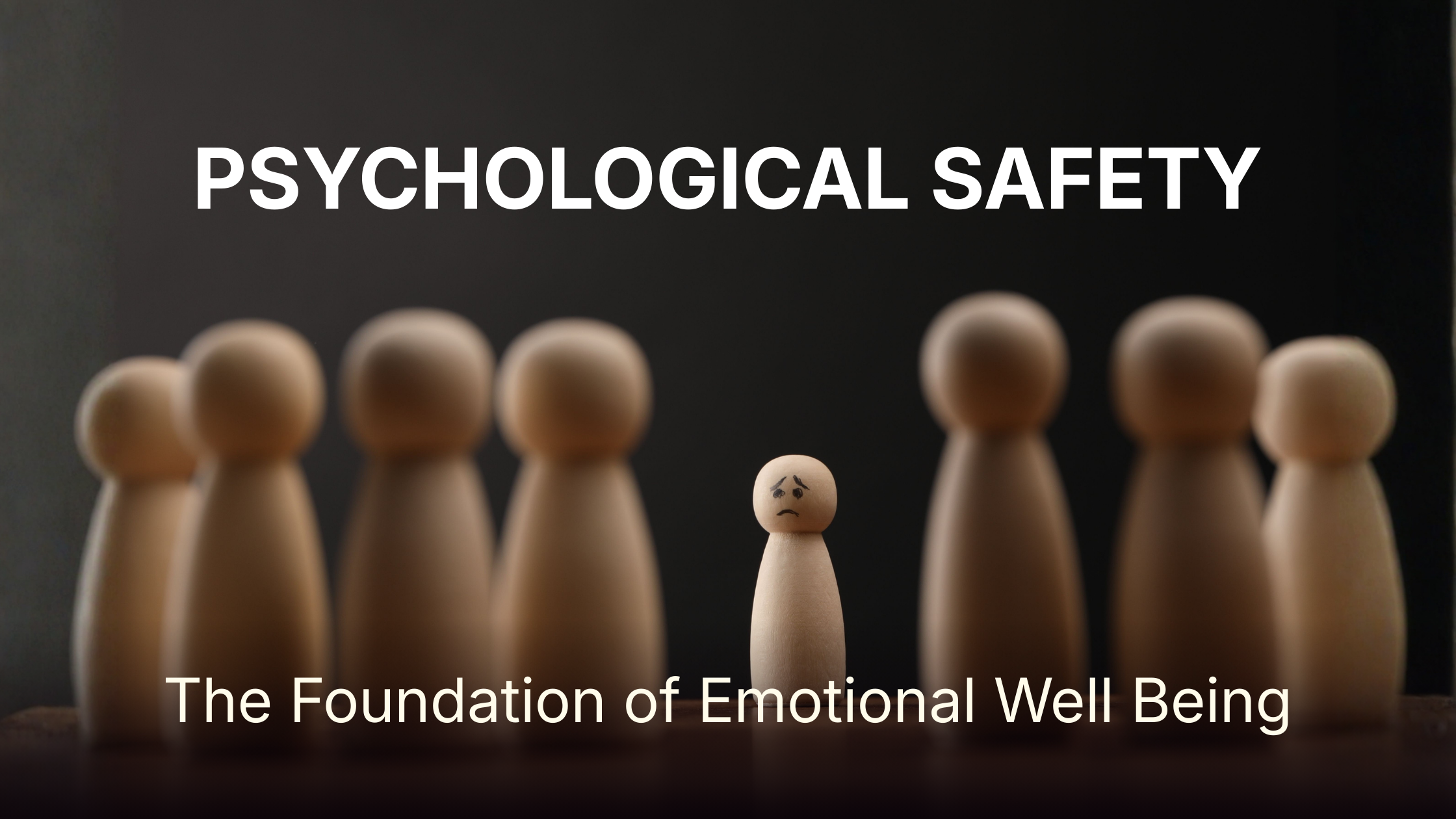
Psychological Safety: The Foundation of Emotional Wellbeing

In the present rapid life, people have started to be concerned about emotional well being. However, when the time comes to express ideas, concerns and emotions people still think it is difficult. In this case the concept of psychological safety arises. Even now a days psychological safety at work also become a serious issue for workplace wellbeing.
The psychological safety meaning refers to the environment where people feel comfortable to speak, ask questions,express their ideas and can admit mistakes. Basically they become free without the fear of embarrassment and punishment. When people feel psychological safety at work and social gatherings, they feel valued and recognized. Hence, it helps to increase their confidence, creativity and overall workplace wellbeing.
Therefore psychological safety can give a healthy and supportive environment where students and professionals can learn and express themselves easily.

Understanding psychological safety and its impact
The psychological safety meaning in everyday life
It should be understood that psychological safety extends beyond the workplace. It is also applicable for classrooms, teams and even families. Basically, psychological safety means when one shares his thoughts and emotions he should be respected.
People start to express themselves freely when one feels psychologically safe. They can share their thoughts freely without the fear that people will criticize them. Even admitting mistakes freely become easy for them. In fact, it builds trust and makes the relationship more strong.
On the other hand, when there is no feeling of being psychologically safe, people keep silent. They may feel that what they are thinking may not be good to share. As a result, one may feel stressed, anxious and even emotionally drained.
Psychological Safety at Work to improve workplace wellbeing
Psychological safety at work is very important to build a healthy workplace. When employees feel comfortable to speak up at that time they contribute their efforts to generate ideas and solutions.
Teams with psychological safety have the following characteristics:
- Better collaboration
- More innovation
- Better relationships
- Improved workplace wellbeing
When leaders motivate employees to participate in open communication then they feel heard and valued. Beside that it creates a positive environment where productivity and wellbeing increase together.
On the other hand, organizations with psychological safety challenges have communication gaps and low morale.
Encourages learning and growth
People expect growth when they do experiments and mistakes and it is an essential aspect of life. But people have often been afraid to fail and stop to try something new.
A culture of feeling psychologically safe helps people get rid of this fear. People can freely ask questions, share their ideas, and even try out something new.
This helps in continuous learning. People learn more in class than they would have without psychological safety. In the workplace, people can freely share their ideas, which helps in better growth.
Personal development is achieved through learning and growth, which is promoted by psychological safety.
The 4 stages of psychological safety
Timothy Clark, a renowned expert in organizational behavior gave a model on psychological safety. According to his model, it follows a four stage process.
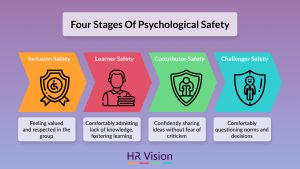
Stage 1: Inclusion Safety
This stage makes people feel included in a particular group. The need to be included in a particular group is a universal feeling. This stage lets people feel included regardless of their background or position.
Stage 2: Learner Safety
This stage involves the power of learning. In fact, this stage lets people ask questions or even fail. This is why in a learner safety environment students participate actively and employee become innovative. They can even take failure as a part of learning and feel less anxiety and more motivation.
However, this stage is crucial in the development the feeling of psychological safety.
Stage 3: Contributor Safety
Contributor safety gives people the confidence to contribute their knowledge and skills. At this stage, people feel free to contribute their ideas, solutions and suggestions.
In addition, this stage greatly benefits the organization. At this stage, employees start to take responsibilities with initiation.
Teams that have attained this stage have shown a high level of engagement and emotional well being.
Stage 4: Challenger Safety
This is the final stage. At this stage, people have the confidence to challenge the current processes or ideas. At this stage, people feel free to contribute their ideas.
This stage is very important to the organization. This stage is essential for any organization that wants to be innovative. As they work on challenger safety they can adapt fater and effectively solve the problem.
Without this stage, the organization will be stagnant.
Build psychological safety in everyday situations
Leaders and teachers have a huge impact on psychological safety
Leaders, managers, and educators have a huge impact on creating psychological safety at work or anywhere. Their behavior becomes an example for the entire group- may be in the office or education sector.
They can build emotional as well as workplace wellbeing by:
- Listening to others actively
- Valuing different opinions
- Dealing with mistakes in a calm way
- Encouraging questions and ideas
When the leader is sympathetic and open minded, others will follow him as anexample. This is a simple but powerful way out to change the group’s behavior to promote psychological safety at work.
Communication is the foundation
Communication is the foundation of feeling psychologically safe in any environment. A person should feel comfortable sharing his or her ideas as well as concerns.
Communication can be improved in the group by the following ways:
- Encourage to give positive feedback
- Not blaming others for mistakes
- Recognizing others in front of the group
- Asking for others’ opinions during the conversation
When the group is open-minded and transparent in their communication, trust will follow. This is the foundation of psychological stability in the workplace.
Respect and inclusiveness contribute to psychological safety
Respect is one of the main core elements of feel psychologically safe. Because of it everyone might feel like their point of view matters for others.
An inclusive environment pushes all members to participate. Having different points of views is usually beneficial in decision making, because it can generate innovative solutions.
Inclusive workplaces also tend to have strong aspects of psychological safety at work. Employees feel valued no matter what their position, background or experience.
This feeling of belonging is usually beneficial for one’s emotional well being.
The 5 pillars of psychological safety ( Gina Battye Model)
Most experts have also developed practical models that illustrate psychological safety. One such model is Five Pillars of Psychological Safety model by Gina Battye. This model provides a practical understanding of how individuals, teams and leaders can work together.
Each pillar explains different aspects of human behavior and team interaction. Moreover, psychological safety at work is enhanced and consequently overall workplace wellbeing and emotional well being also improved.
Self(Authenticity & Awareness)
The self pillar helps individuals feel comfortable enough to come to work without masks or pretenses. It is important to feel comfortable enough to be your true self, genuine one. The self pillar helps individuals become more authentic at work. When people are comfortable enough to be themselves, it is easier for teams to feel more psychologically safe as a result of their authenticity.
As authenticity increases within a team, psychological safety is also enhanced as individuals feel comfortable enough to be themselves. Eventually this pillar help to enhance emotional well being.
Social (Communication)
The Social pillar is centered on the “Communication Cycle,” which examines the nature of communication within conversations. Communication is not just speaking but it involves listening, interpreting reactions and evaluating the emotional responses of the people with whom you communicate.
When people become aware of the factors that determine their responses to communication, people start to communicate more.In fact, this will make relationships better and enhance psychological safety at work, where people feel free to express themselves.
Collaboration (Teamwork & Belonging)
The Collaboration pillar focuses on building trust on each other and shared goals within teams. Through the use of tools such as CollabZen, teams will be able to set the ground rules and eventually can do effective teamwork.
People will feel more a part of the team when the quality of cooperation is improving. In essence, this type of setting promotes active participation and can improve general workplace wellbeing and consequently emotioonal well being also increase.
Curiosity (Learning & Reflection)
The Curiosity pillar focuses on the activity to learn and to do experiment on new ideas. In this case people are not afraid to ask questions, seek knowledge and generate new ideas.
When people make mistakes, they should not think that they have been failed. Instead of that,people should take this as learning opportunities. This promotes continuous learning through feedback and evaluation. Because of this psychological safety at work is strengthened which consequently affect emotional well being.
Creativity (Problem Solving & Innovation)
Finally, the pillar is creativity. This pillar talks about adopting new ideas and perspectives.In fact, in psychologically safe workplaces employees should feel free to suggest creative ideas and can raise questions on existing solutions.
Instead of discouraging employees from taking risks, the Organisation encourages employees to be innovative instead of demotivating them to take risks. This promotes effective problem solving while enhancing workplace wellbeing as well as overall emotional well being.
How psychological safety improves emotional well being
Psychological safety is interconnected with emotional well being.
When people feel psychologically safe:
- Their stress levels come down
- Confidence increases
- Capacity to cooperate increases
- Their capacity to be creative increases
- They become more emotionally resilient
These reasons explain why today’s organizations regard psychological safety at work as a strategic imperative, not a soft skill.vIn fact, several studies have found that organizations that score higher on psychological safety exceed others in terms of innovation, problem solving and workplace wellbeing. Moreover, building small habits can change life positively and can also improved emotional health.
Final Thought: Why psychological safety creates healthier environments
In an environment that expects people to perform at perfect levels, the value of psychological safety is that which gives people the freedom to simply be human.
When people can express their ideas, feelings and mistakes freely, they can grow with confidence. Teams can collaborate better, organizations can innovate faster and people can experience better emotional well being.
In classrooms, in offices or in communities psychological safety is a kind of environment that must be created.
Here is an important question to consider:
In your environment, does psychological safety thrive, or do silenced voices need to be heard?