Which Cars Is Better? Electric vs Hybrid vs Petrol

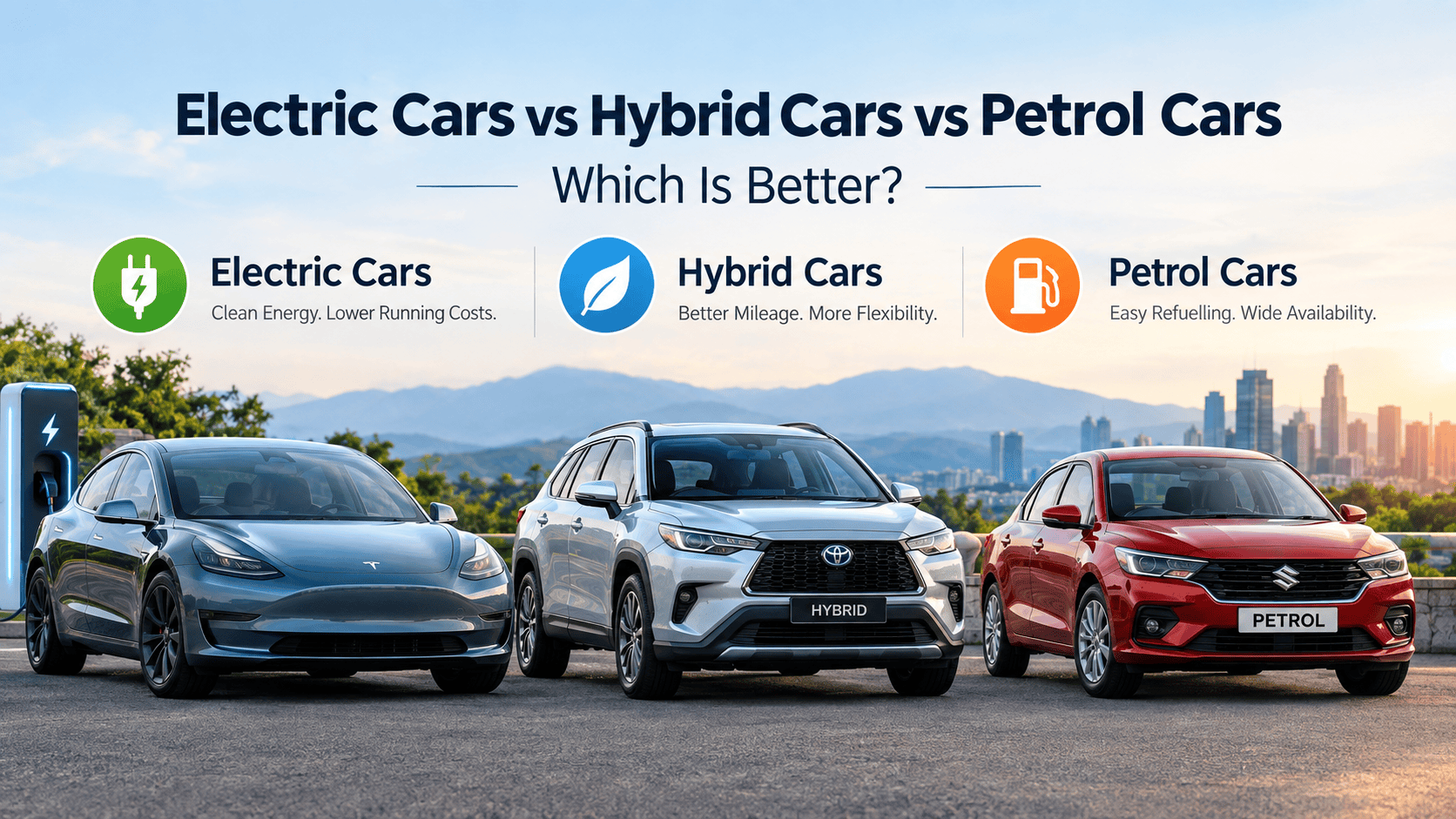
Buying a car today involves more than choosing your favourite model. Buyers now have three major options: electric cars, hybrid cars, and petrol cars. Each option has its own benefits depending on purchase cost, performance, maintenance, fuel efficiency, and everyday convenience.
So, which one should you buy? Should you choose an electric car because of its potentially lower running costs, a hybrid car for better fuel efficiency, or a petrol car for easy refueling? This guide compares electric cars vs hybrid cars vs petrol cars to help you make a practical decision.
Why Electric Cars Are Becoming Popular
Electric cars are becoming more common as buyers look for alternatives to traditional fuel-powered vehicles. An electric vehicle (EV) uses electricity stored in a battery to power an electric motor instead of using a petrol engine.
One major advantage of electric cars is their running cost. Depending on electricity prices, charging method, vehicle efficiency, and annual mileage, an EV can cost less to operate per kilometer than a petrol car. EVs also have fewer moving mechanical parts, which can simplify routine maintenance.
Electric cars also offer a quiet driving experience. Their electric motors can deliver instant torque, which provides quick and smooth acceleration.
However, buyers should consider charging access, driving range, purchase price, and their usual travel patterns before choosing an EV.
Electric Cars and Lower Running Costs
One of the biggest attractions of electric cars is their potential to reduce daily running expenses. Unlike petrol cars, EVs do not need petrol or diesel to operate.
Home charging can be particularly convenient for people who have a dedicated parking space and follow a regular daily driving routine. However, the actual cost depends on the vehicle’s efficiency, electricity tariff, charging losses, and whether you use home or public charging.
Electric cars can also reduce some routine service requirements because they do not use engine oil and have fewer conventional engine components.
Electric Cars and Their Main Advantages
Electric cars offer several advantages beyond their running costs. They provide quiet operation, instant torque, smooth acceleration, and a different driving experience from conventional petrol vehicles.
EVs also use technologies such as regenerative braking. This system can recover some energy during deceleration and send it back to the battery.
Battery technology and charging systems continue to develop, giving buyers more choices than before. However, the right EV still depends heavily on your daily travel distance and charging access.
EV Charging and Range
Charging is one of the most important factors to consider before buying an electric car.
People with home charging access may find EV ownership easier because they can charge the vehicle overnight or during periods when it is parked. Public chargers can also help during longer journeys, but availability can vary by location.
Buyers should also avoid relying only on the manufacturer’s claimed range. Real-world range can change because of driving style, traffic, weather, road conditions, air-conditioning use, and vehicle load.
Hybrid Cars: An Alternative Approach
Hybrid cars combine a petrol engine with an electric motor and battery. This allows the vehicle to use electric assistance when it can improve efficiency.
For many buyers, hybrid cars provide a middle ground between petrol cars and fully electric vehicles. They can offer better fuel efficiency while retaining the convenience of using regular petrol stations.
Hybrid technology has become increasingly relevant in India, with strong hybrids offering an option for buyers who want better city efficiency without depending on external charging.
How Hybrid Cars Work
A hybrid car can use its petrol engine, electric motor, or both depending on the driving situation.
During braking or deceleration, regenerative braking can recover energy and help recharge the battery. The electric motor can then assist the petrol engine during acceleration and other situations where electric assistance improves efficiency.
Not all hybrids work in exactly the same way. Mild hybrids, strong hybrids, and plug-in hybrids have different systems and capabilities, so buyers should understand which type they are considering.
Hybrid Cars and Fuel Economy
Hybrid cars can be especially useful in city traffic. Frequent stopping and starting gives the electric motor more opportunities to assist the petrol engine.
This can help a hybrid achieve better fuel economy than a comparable conventional petrol car. However, actual mileage depends on the model, traffic, driving style, road conditions, and how the vehicle is used.
A strong hybrid can be particularly attractive for people who want better efficiency but do not have convenient access to home charging.
Hybrid Cars vs Electric Cars
The main difference between hybrid cars and electric cars is their energy source.
An electric car relies entirely on its battery and electric motor for propulsion. It needs to be charged using a suitable charging source.
A conventional strong hybrid, on the other hand, combines a petrol engine with an electric motor. It can use petrol when the battery cannot provide enough electric assistance, so the driver does not depend on charging stations in the same way as an EV.
This makes hybrids appealing to buyers who want improved fuel efficiency without changing their normal refueling habits.
Petrol Cars: Why Are They Still Popular?
Petrol cars remain a familiar choice for Indian buyers because they are convenient and widely supported.
Petrol stations are available across cities, towns, and major highways. Refueling usually takes only a few minutes, and petrol cars are available across many price segments, from affordable hatchbacks to SUV and premium vehicles.
For buyers who do not want to plan their journeys around charging points, petrol cars can still offer a simple ownership experience.
Petrol Cars and Long-Distance Travel
For frequent long-distance travelers, petrol cars offer the advantage of quick refueling. You can stop at a petrol station, fill the tank, and continue your journey without waiting for a battery to charge.
This can be particularly useful on routes where charging infrastructure is limited or unpredictable.
However, frequent fuel use can become a significant part of ownership costs over several years. Therefore, buyers should consider annual mileage rather than looking only at the initial purchase price.
Petrol Cars and Maintenance
Petrol cars use internal combustion engines with many mechanical components. Routine maintenance can include engine oil changes, air-filter replacement, spark-plug replacement, fluid checks, and other engine-related servicing.
Maintenance costs vary between models and manufacturers. Before purchasing a petrol car, buyers should check the expected service schedule and long-term ownership costs.
Each powertrain has a different strength.
Electric Cars: Best for Lower Running Costs
Electric cars can be a strong option for people who drive regularly in cities and have reliable access to charging. They offer quiet operation, instant torque, and potentially lower energy costs.
However, buyers should consider the purchase price, charging availability, battery warranty, and expected ownership period.
Hybrid Cars: A Balance of Efficiency and Convenience
Hybrid cars offer a practical middle ground. They can improve fuel efficiency while allowing drivers to continue using petrol stations.
They may work particularly well for people who spend a lot of time in city traffic but also take regular highway trips.
Petrol Cars: Best for Easy Refueling
Petrol cars remain attractive because of their simple refueling process and broad availability.
They can be a practical choice for buyers who drive fewer kilometers, travel frequently to places with limited charging infrastructure, or want a familiar ownership experience.
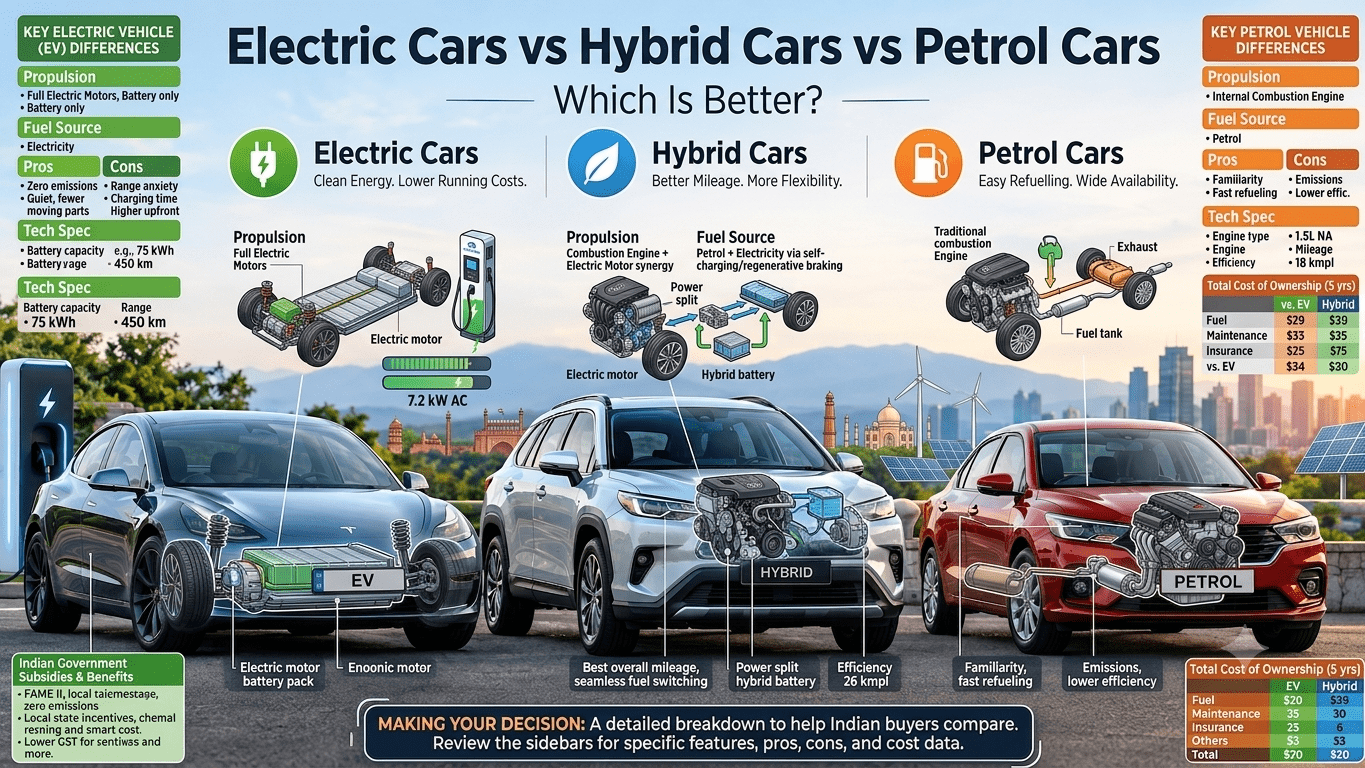
Electric Cars, Hybrid Cars and Petrol Cars: Cost Comparison
Purchase price should not be the only factor when comparing these three options.
An electric car may have a different upfront price from a comparable petrol or hybrid model. Buyers should also consider charging or fuel expenses, insurance, maintenance, battery warranty, resale value, and expected ownership period.
Hybrid cars can cost more than comparable petrol versions because of their additional electric motor and battery system. However, fuel savings may help recover part of that additional cost over time.
Petrol cars can have an attractive initial price, but regular fuel and maintenance expenses can add up over several years.
Understanding Total Cost of Ownership
The better approach is to calculate the total cost of ownership instead of focusing only on the showroom price.
Consider:
- Purchase price
- Fuel or charging cost
- Annual kilometers
- Insurance
- Maintenance
- Battery warranty
- Service costs
- Expected resale value
- Ownership period
For example, an EV may offer lower running costs, but the financial benefit depends heavily on charging access and how many kilometers you drive. Similarly, a hybrid may save fuel but have a higher purchase price.
Which Car Is Best for Indian Buyers?
There is no single answer for every buyer. Your driving pattern should determine the right choice.
Best Choice for Urban Driving
If most of your driving happens within a city and you have reliable charging access, an electric car can be a strong option. It offers smooth driving and may reduce daily running expenses.
A hybrid can also work well in cities because its electric motor can assist the petrol engine during frequent stopping and starting.
Best Choice for Long-Distance Travel
If you regularly travel long distances, a petrol or hybrid car can offer greater refueling convenience.
An EV can also handle long-distance journeys, but you need to plan your route around charging points and charging time. A recent road-trip comparison similarly highlighted that EV convenience on longer journeys depends strongly on charging availability.
Best Choice for Lower Operating Costs
Electric cars can offer very low energy costs when charged at home. However, the overall savings depend on electricity prices, annual mileage, purchase price, maintenance, and ownership period.
So, do not assume that one powertrain will always be cheaper. Compare the complete ownership cost based on your own usage.
Final Verdict: What Type of Car Should You Buy?
It would be difficult to say that electric cars, hybrid cars, or petrol cars are the universal winner. The best choice depends on how, where, and how often you drive.
Choose an electric car if you have reliable charging access and want potentially lower running costs and a quiet driving experience.
Choose a hybrid car if you want better fuel efficiency but still want the convenience of petrol refueling. Strong hybrids can be especially useful for buyers who drive frequently in cities but also travel on highways.
Choose a petrol car if quick refueling, widespread fuel availability, and a familiar ownership experience are your priorities.
Before making your decision, compare the purchase price, running costs, maintenance, charging or refueling convenience, expected mileage, and ownership period.
Ultimately, the best car is not simply the one with the newest technology. It is the one that fits your budget, lifestyle, driving habits, and long-term plans.
So, what would you choose for your next car — electric, hybrid, or petrol?