Best No-Maida Bread Under ₹100 Tastier Than a ₹450 Artisan Loaf

You’ve paid ₹450 for a fancy sourdough boule from that bakery with the exposed brick and the tote bags, and somewhere between the first bite and the second, you thought, “Wait, this doesn’t actually taste that different from the multigrain I get delivered every morning.” You weren’t imagining it. And you definitely weren’t wrong. Whether it’s a warm slice of no-maida toast at 7 am or a proper Mumbai-style pav dunked in bhaji, nothing beats bread that’s actually honest about what’s in it — and increasingly, that honest bread isn’t coming from a boutique.
Why India Is Falling Out of Love With Maida
For the longest time, “brown bread” was just shorthand for healthy. You picked the brown loaf over the white one, felt slightly virtuous, and moved on with your life. Then somewhere along the way, people actually started reading the ingredient list on the back of the packet — and a lot of that “brown” bread turned out to be regular white bread with a bit of caramel colour thrown in and a very confident marketing team behind it. Once that secret got out, it didn’t stay quiet for long. What started as a few health bloggers grumbling online has turned into a genuine clean-label movement, and honestly, it hasn’t shown any sign of slowing down. The global clean-label bread market was worth somewhere around ₹98,000 crore in 2025, and it’s expected to nearly double by 2032 — and a good chunk of that growth is coming straight out of Indian metros.
It helps that this isn’t happening in a vacuum. The same decade that gave us intermittent fasting, macro tracking, and a national obsession with gut health also gave us a generation of shoppers who genuinely enjoy reading nutrition panels the way older generations read newspapers. Bread, which used to be the one aisle nobody questioned, suddenly became the aisle everyone had opinions about.
No-Maida Bread: The Quiet Health Revolution Happening on Your Breakfast Table
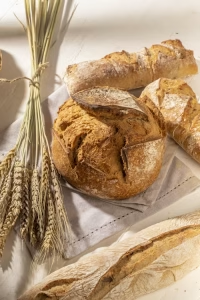
Image Source-Unsplash
Why Everyone’s Suddenly Reading Bread Labels
Here’s the thing about fitness apps and calorie counters — once you start using them, you can’t really unsee the numbers. Refined carbs became public enemy number one pretty quickly, and bread, being the single most eaten refined-carb product in most Indian households, got dragged straight into the spotlight. “No maida” went from being a niche claim you’d only see on a health-food blog to something people now genuinely scan for at the supermarket, right next to the expiry date.
The Zero-Maida Brands Leading the Charge
It’s not just talk, either. Brands like The Health Factory and BreadWinner have built their entire identity around the zero-maida promise, and it’s working — The Health Factory alone has raised serious funding and is now sitting on quick-commerce shelves across Mumbai, Delhi, Bangalore, and Chennai. Open Zepto or Blinkit on any given morning and you’ll find an entire section dedicated to “clean label” bread that simply didn’t exist five years ago. This isn’t a fringe trend anymore. It’s just what bread looks like now, if you’re paying attention.
What “No Maida” Actually Means (and What It Doesn’t)
Quick reality check before you go throwing out every loaf in your kitchen: “no maida” specifically means the bread is made using 100% whole wheat, multigrain, or some combination of ancient grains instead of refined flour. That’s it. It does not automatically mean the bread is sugar-free, low-calorie, or free of preservatives — those are separate claims, and brands love to let one good claim do the work of three. So it’s still worth flipping the packet over and actually reading it, rather than trusting the big bold letters on the front.
A loaf of Danz’s No-Maida Bread — baked fresh the night before and sitting on your doorstep by 8 am — usually costs somewhere between ₹75 and ₹95. Compare that to a similar clean-label promise from a trendy neighbourhood bakery, where you’re often looking at ₹350 to ₹600 for a single sourdough loaf. And honestly? The difference isn’t always in the ingredients. Sometimes it really is just the packaging, the exposed-brick café, and whatever filter got used for the Instagram post.
A Quick Checklist for Reading Any Bread Label
Since we’re already on the topic, here’s a genuinely useful five-second habit: before you buy any loaf calling itself healthy, flip it over and check for three things. First, is refined wheat flour (maida) listed anywhere in the first three ingredients — because if it is, no amount of “wholesome” branding on the front changes that. Second, how long is the ingredient list — a shorter, more recognisable list is almost always a better sign than a long one full of names you’d need to Google. And third, does the sugar content match what you’d expect from bread, or does it read more like a dessert wearing a loaf’s clothing. It takes less time than scrolling past the ad for the same bread on Instagram, and it tells you more.
Multigrain Bread: The Everyday Hero Nobody Talks About
Multigrain bread doesn’t get nearly enough credit. It doesn’t have the drama of a sourdough starter that needs feeding twice a day, and it definitely doesn’t have the social media buzz of “zero maida” printed in bold gold letters. But a genuinely good multigrain loaf — one made with five or more actual whole grains and real fibre, not just decoration — quietly does more for your daily nutrition than most of the trendier options combined. The catch is that not every loaf labelled “multigrain” on the shelf actually earns it. Some are just white bread dressed up with a sprinkle of seeds on top for the photo. The only real way to know is to read the ingredient panel, not the packaging copy.
Sourdough and Artisan Bread: Worth the Hype, Not Always Worth the Price
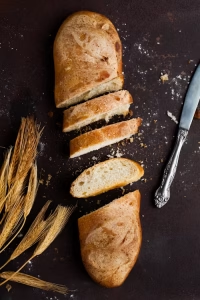
Image Source-Unsplash
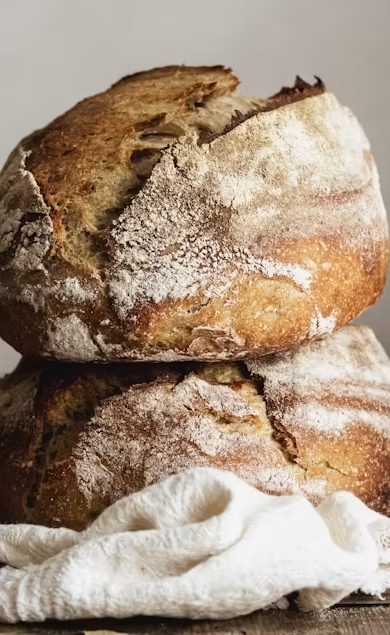
Let’s be fair here — a properly fermented sourdough does taste incredible. That tangy crust, the open, uneven crumb, the slightly sour edge that a regular loaf just can’t replicate. Mumbai’s boutique bakeries have built genuinely loyal followings around this, and they’ve earned it. A 24 to 36 hour fermentation process is real, skilled work, and small-batch production costs real money to run. All of that shows up honestly in the price tag, which typically lands somewhere between ₹350 and ₹600 per loaf at Mumbai’s better-known artisan bakeries. That’s a fair price for what it actually is — a slow, handmade product made by people who care about the craft. It’s just not the only way to eat clean, honest bread on a random Tuesday morning when you’re already running late for work.
There’s also a slightly awkward truth nobody in the artisan-bread world likes to say out loud: not every sourdough loaf you’re paying a premium for is actually that different from a well-made whole wheat loaf, nutritionally speaking. The tang comes from the fermentation process and the wild yeast culture, which genuinely does help with digestibility — but “sourdough” isn’t automatically synonymous with “healthier.” It’s a texture and flavour choice as much as a health one, and there’s nothing wrong with that, as long as you’re not paying the premium under the wrong assumption
Danz Foods: Proof That Clean-Label Bread Doesn’t Need a ₹450 Price Tag
This is basically the exact gap Danz Foods was built to fill. Since 2011, Danz has been quietly baking preservative-free, no-maida bread every single night and getting it to doorsteps across Mumbai somewhere between 5 am and 8 am — no potassium bromate, no artificial colours or flavours, no hydrogenated oils hiding in the ingredient list. It’s the same clean-label promise you’d get from a boutique sourdough bakery, just without the boutique markup, and without you having to leave the house before your coffee’s even ready.
What actually makes this work is the subscription model itself. You’re not choosing between “healthy” and “convenient” the way you would be with a bakery you have to physically visit before it sells out. You pick your bread, set how often you want it, and the rest happens quietly in the background — dough mixed and proofed in the evening, baked through the night, and out for delivery before most of the city has even woken up. If you’re travelling, you pause it. If you suddenly need extra loaves for a weekend of guests, a message on WhatsApp sorts that out too. None of this requires you to think about bread until the moment you’re buttering a slice of it.
City-by-City: Where Clean-Label Bread Is Actually Winning
Mumbai
Mumbai is basically ground zero for India’s clean-label bread movement. It’s home to some of the earliest doorstep-subscription bakeries — Danz being one of the first — and it also has a genuinely thriving artisan sourdough scene tucked into Bandra, Khar, and Powai. Two very different approaches to the same idea, both doing well.
Delhi
Delhi’s health-food boom has pushed zero-maida and millet bread onto supermarket end-caps all across South Delhi and Gurugram, and most of that growth is honestly being driven by quick-commerce rather than physical stores.
Bangalore
Bangalore’s fitness-obsessed crowd has more or less made high-fibre, high-protein bread a staple item — you’ll find it stocked in cafés and dark stores throughout HSR Layout and Indiranagar, sitting right next to the protein bars.
Hyderabad
Hyderabad’s a slightly quieter but fast-growing market for millet-based and ancient-grain bread, riding the same broader wave that’s reshaping how the rest of urban India thinks about grains.
The Real Cost of Your Daily Bread: The Numbers Don’t Lie
Image Source-Unsplash
Let’s actually break this down for anyone who likes seeing the math laid out plainly, because the numbers really do tell their own story here.
| Bread Type | Danz Foods (Subscription) | Zero-Maida Quick-Commerce Brand | Artisan Bakery (Mumbai) |
|---|---|---|---|
| No-Maida / Whole Wheat Loaf | ₹75–₹95 | ₹55–₹79 | ₹350–₹600 |
| Multigrain Loaf | ₹75–₹95 | ₹70 | ₹360–₹450 |
| Sourdough / Artisan Style Loaf | — | — | ₹170–₹600 |
The pattern here is pretty hard to miss. Clean-label bread delivered on subscription isn’t some watered-down compromise on quality — it’s the exact same promise, minus the rent for a café address and minus the “artisan” label doing a lot of the pricing work.
Bread Subscriptions: Why “Set It and Forget It” Actually Wins
Beyond just the savings, there’s a more boring but arguably more important problem that subscriptions solve — remembering to buy bread at all. A custom delivery schedule, the ability to pause things when you’re travelling, and a fresh loaf that just shows up before you’ve even had your first cup of chai — it removes the decision entirely. That’s probably exactly why subscription-intent searches around bread are growing faster right now than almost any other keyword in this category in India.
Final Thought: Good Bread Shouldn’t Be a Luxury
So the next time someone insists that a ₹450 artisan loaf is the only “real” clean-label bread worth eating, smile, nod politely, and quietly mention the fresh no-maida loaf that showed up at your door before 8 am for a fifth of the price. Good bread was never supposed to be a luxury item you save for weekends. It was just supposed to be breakfast — the kind of thing you don’t have to think twice about, plan a café trip around, or feel a little guilty for choosing.
Clean-label bread isn’t a compromise you make to save money. It’s simply the smarter choice — and these days, it happens to be the more affordable one too. Somewhere between the health blogs, the funded startups, and the quiet subscription bakeries that have been doing this since long before it was trendy, Indian bread finally caught up to what its ingredient label should have said all along.
Loved this blog? Share it with the friend who still insists a ₹450 loaf is the only healthy one out there. And tell us in the comments — what’s the one bread claim on packaging you never actually trust?
So, for more food content, keep learning and keep reading with us!