

Intermittent Fasting and Modern Eating Patterns: Science vs. Trends

As we can see that Intermittent fasting (IF) has become very popular as a diet in the last decade, from advertising on social media to health apps it is promoted by celebrities, IF is a simple way to lose weight and improve our metabolism. It basically sits under the ancient practices of modern lifestyle trends.

Whereas on the other hand we see that today’s eating pattern with multiple snacks, late-night meals, and high consumption of ultra-processed foods can create a nutritional environment which is eventually very different from that of our ancestors.
In this article, we will get to know about the intermittent fasting which generally contrast with constant calorie restriction.
What Is Intermittent Fasting? The Most Common Methods
We can say that the Intermittent fasting is often described as a diet but in reality it isn’t a single based diet but more than a pattern based periods between eating and fasting.
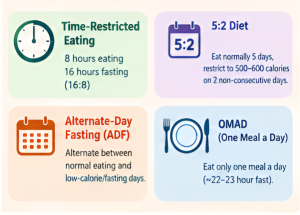
The most common practice approaches are mentioned below
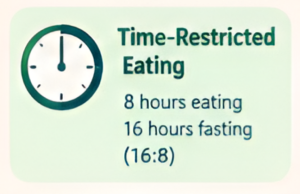
Time-Restricted Eating:
This is one of the easiest protocols to follow because it restricts the eating hours of 8 hour time frame each day and thus it will help to maintain a fast for the remaining 16 hours of the day. This is the most studied form of Intermittent fasting.
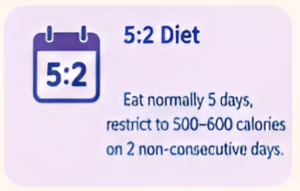
Diet:
If we eat normally on 5 days of the week and restrict calories to 500/600 on 2 non-consecutive days of the week then it will affect on our health by excessive consumption of calories.
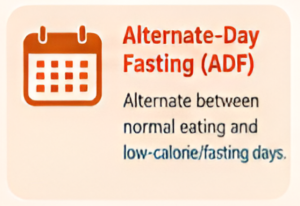
Alternate-Day Fasting (ADF):
if we develop the Alternate days of normal eating then we can gain low calorie intake or even fasting.
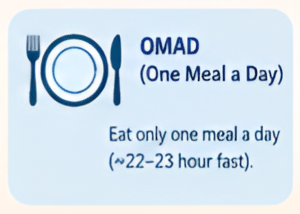
OMAD (One Meal a Day):
We must try to eat only one meal on a day instead of every meal; this will help us to keep basically a 22–23 hour fast.
The Science: What the Evidence Actually Shows
We can find the recent evidence which largely comes from systematic reviews and network meta-analysis published between 2024 and 2026. The biggest 2025 network meta-analysis was published in The BMJ. The authors of this analysis included 99 random clinical trials which involve more than 6,500 adults.
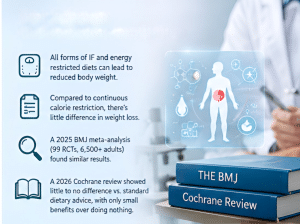
Many studies have found that all forms of intermittent fasting as well as energy restricted diets result in reduced body weight compared to eating without restriction. When intermittent fasting was compared to continuous calorie restriction for weight loss, little difference was found. Alternate-day fasting did have shown weight loss which gives much advantage in shorter trials.
The 2026 Cochrane review compared intermittent fasting with other dietary approaches for weight loss. When expressed as a percentage loss of initial body weight, there was little to no difference from the comparison with standard dietary advice for weight loss. There were some small benefits over doing nothing but these were often below clinically meaningful for most people.
Metabolic and Cardiometabolic Effects
As we can see that in addition to the weight loss, studies have investigated the effects of IFL on glucose, insulin sensitivity, lipid parameters, blood pressure and liver fat.
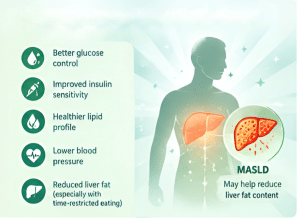
We can control this with time restricted eating which is likely to be most beneficial for patients with metabolic dysfunction-associated steatotic liver disease (MASLD) with regard to reduction of liver fat content.
Circadian Rhythms and the Timing of Meals
We know that one of the reason for intermittent fasting is based on the circadian system. The metabolism in humans is not evenly distributed over the 24 hours of the day. So, the insulin sensitivity and glucose utilization as well as the fat burning increases during the day and night.
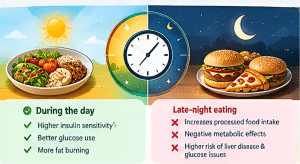
Eating outside of our natural biology has become the norm in modern times. Consuming late night meals and failing to allow adequate time for overnight fasting increases consumption of processing foods and leads to negative metabolic effects. In some studies populations that eat later in the day are found to have increased risk of liver disease and glucose in some analysis.
Trend claims often overstated:
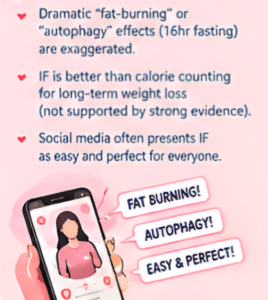
– Dramatic “fat-burning” or “autophagy” effects of 16hr daily fasting schedules are generally greatly exaggerated as significant autophagy activation requires longer, more severe studies on human subjects.
– The claim that IF is better than calorie counting for long term weight loss is not supported by strong evidence.
– We all know that the social media mostly present the intermittence fasting in a very positive light by highlighting it as easy to implement and positivity for everyone.
What the science supports:
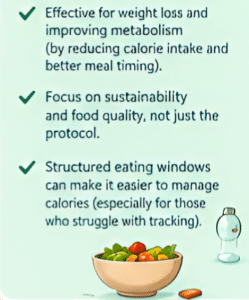
– IF can be very effective for weight loss and improving metabolism in most people by reducing their calorie intake and possibly improving their timing of eating meals.
– Focus on the sustainability and quality of the food you eat within your eating window and not on the specific protocol of your Fast.
– We know that the structured eating window of an Intermittent fasting can make it easier for people to manage their calories by giving them a diet chat of their food plan, particularly for those who find the tracking of the calories on an ongoing basis very difficult.
Who Should Approach Intermittent Fasting with Caution
There are some individuals for whom even intermittent fasting requires caution or even medical supervision:
– People with a history of eating disorders.
– Pregnant individuals.
– Children and adults.
– Individuals especially those who have health conditions.
– Individuals especially those who have type 1 diabetics.
Practical Takeaways for Modern Eaters

- We must stick to consistency and sustainability rather than extreme ways of eating.
- Our timed eating will not make up for a poor diet, but by eating nutrient dense foods can help us to minimally processed during our eating times.
- We must consider our time shift of our eating window to earlier hours of the day.
- We must Integrate IF with other proven habits such as adequate sleep, physical activity, and stress reduction.
- We must keep our self aware regarding how we are feeling, including energy levels, sleep, performance in training and general mood.
- We must keep in mind that it doesn’t matter for regarding the fact about whether we are healthy or unhealthy but it is always a good idea to get advice from health care professionals before we start Intermittent Fasting, especially if we have any health problems.
Conclusion
In conclusion Intermittent fasting is not a solution to cure for all. Intermittent fasting can be an effective tool for helping individuals with weight management and metabolic health and its effects are equivalent to those of continuous calorie restriction for most individuals.
If you want to know more then visit here: Intermittent Fasting Strategies