
Is AI Agent the Future of Technology?

Introduction to AI Agent and It’s Impact
Artificial Intelligence (AI) continues to transform how humans interact with technology, and one of its most exciting developments is the Agent in AI. Designed to think, learn, and act independently, these AI agents are revolutionizing industries — from education and corporate systems to everyday AI agent tools.AI Agent Architecture defines the internal design and structure that determines how an agent of AI perceives its environment, makes decisions, learns, and acts.
For students, corporate officers, and tech enthusiasts alike, understanding agents in AI is essential, since it provides deep insight into how intelligent systems function, learn, and evolve.
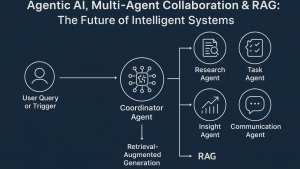
Image source : https://www.linkedin.com
What Is an Agent in AI and Why It Matters
An Agent in AI is an intelligent entity capable of perceiving its environment, processing information, and performing actions to achieve specific goals. Basic software programs that execute fixed commands . AI agents adapt, learn and optimize decisions based on data and experience.
Ultimately, this remarkable adaptability positions them as the foundation of many modern innovations. In fact, they power technologies ranging from self-driving cars and intelligent chatbots to smart assistants and advanced industrial robots. Consequently, these AI agents continue to transform industries by making systems more responsive, efficient, and intelligent.
How AI Agent Function
Every agent in AI operates through three fundamental components: perception, reasoning, and action. It collects information from the environment through sensors .
Initially, it receives input from the environment; subsequently, it processes this data using algorithms or learned models. After that, it analyzes and interprets the results to determine the most suitable response. Finally, it acts on this information through actuators or output mechanisms, thereby completing the perception-to-action cycle within the AI agent architecture.
Types of AI Agents and Their Use Cases
Understanding the types of AI agents helps in recognizing their practical applications:
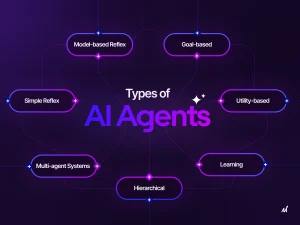
Image Source : www.projectpro.io
Simple Reflex Agents
Operate on condition–action rules. Example: a thermostat that adjusts temperature automatically.Such agents are widely used in manufacturing robots, temperature control systems, and safety alarms where quick, rule-based responses are critical.
Model-Based Agents
Compared to simple reflex agents, model-based agents in AI are far more sophisticated. With the help of advanced AI agent tools, they go beyond relying solely on immediate inputs and instead use internal models to track and interpret changes in the environment. As a result, they can effectively handle partial or incomplete information, continuously update their understanding, and thereby enhance their adaptability and decision-making accuracy.
Goal Based Agents
Goal-based AI agents introduce a clear sense of purpose into the decision-making process.Instead of simply reacting to situations, goal-based AI agents actively analyze their environment. First, they consider a range of possible actions, and then, they carefully evaluate the potential outcomes of each one. After that, they select the option that best aligns with their goals and most effectively achieves the desired result. For instance, they may compare multiple routes, weighing factors such as distance, time, and traffic conditions, and ultimately choose the most efficient path to optimize overall travel time.
Utility-Based Agents
In contrast to simple goal-based agents, utility-based agents in AI aim not only to achieve their objectives but also to maximize overall efficiency and satisfaction. Therefore, they evaluate multiple outcomes, compare alternatives, and select the action that provides the greatest possible benefit in a given sitThey assign value (or utility) to each possible outcome and choose the one with the highest payoff.Choose the best outcomes by maximizing satisfaction or performance.
Learning Agents
The most advanced of all, learning agents have the ability to improve over time through experience. They learn from their successes and failures, updating their internal models automatically. Continuously evolve by analyzing feedback, a hallmark of advanced AI systems.A Learning AI agent tools that improves its performance over time by learning from experience, data, or feedback using AI agent tools .
From automated finance advisors to self-learning chatbots, each type showcases the growing intelligence of agents in AI.
AI Agent Architecture: The Brain Behind Intelligence
An AI agent architecture, in essence, defines how these systems are carefully structured to process data, analyze information, and act intelligently within their environments. It generally includes:
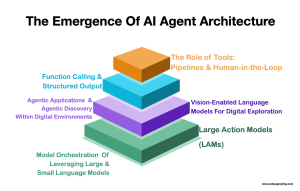
Image Source : cobusgreyling.medium.com
Perception Module
Acts as the sensory system of the agent.Captures raw input from the environment—through sensors, APIs, or user data—and converts it into meaningful information.
Knowledge Base
It serves as the memory and learning repository of the AI agent architecture. In this role, it systematically stores information, facts, rules, and learned experiences. Subsequently, this stored knowledge guides and refines the agent’s decision-making process, thereby enabling more accurate and intelligent actions over time.
Decision Engine
It serves as the thinking center of the AI agent architecture. Initially, in this stage, the system carefully evaluates the agent’s goals. Next, it analyzes and interprets environmental data, and finally, it selects the most appropriate and effective action to achieve the desired outcome.
Learning Component
It enables the AI agent to adapt and evolve over time, allowing it to improve its performance with each interaction. By using machine learning algorithms, the agent continuously refines its decisions based on feedback, new data, or changing conditions. As a result, it becomes smarter, more accurate, and better suited to handle complex situations.
Common AI Agent Architecture Models
Reactive Architecture
A Reactive Agent operates purely based on current stimuli, without relying on past experiences or internal memory.It uses simple “if–then” rules to respond instantly to environmental changes.
Deliberative Architecture
This model, in particular, involves reasoning, planning, and knowledge-based decision-making. Unlike reactive systems, it goes a step further by engaging in deeper reasoning and carefully analyzing different possibilities before ultimately taking action.
Hybrid Architecture
Within the AI agent architecture, a Hybrid Agent, on the other hand, seamlessly combines the speed of reactive systems with the intelligence of deliberative systems. As a result, this architectural approach integrates both rapid response and thoughtful reasoning, thereby making agents smarter, faster, and more adaptable to dynamic and unpredictable environments.
This structured intelligence enables agents in AI to perform tasks efficiently across industries.
Popular AI Agent Tools Powering Innovation
Developers today rely on powerful AI agent tools that simplify the creation, training, and deployment of intelligent systems. Developers rely on cutting-edge AI agent tools to design, train, and deploy intelligent systems:
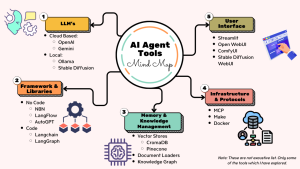
Image Source : www.linkedin.com
TensorFlow Agents
A library built on TensorFlow, TF-Agents is designed for reinforcement learning (RL).
It provides pre-built environments, agents, and training algorithms—allowing developers to experiment with RL models for applications like robotics, game AI, and adaptive control systems.
LangChain & AutoGPT
LangChain and AutoGPT have revolutionized conversational and generative AI by enabling agents to reason, plan, and interact dynamically. LangChain helps developers build context-aware AI agents that can connect to APIs, databases, or other tools.
Microsoft Autonomous Systems Platform
Microsoft’s platform focuses on industrial-scale AI agent tools that drive automation across manufacturing, logistics, and energy sectors.It combines simulation environments, reinforcement learning, and IoT integration to help companies design self-optimizing systems.
OpenAI GPT-based Agents
Built on the GPT (Generative Pre-trained Transformer) architecture, these agents excel at natural language understanding, reasoning, and task automation.
They can summarize information, generate creative content, or even perform structured workflows through prompt-based interactio
These AI agent tools simplify complex development processes, empowering even students and startups to experiment with intelligent automation.
Applications of Agents in AI Across Industries
The use of agents in AI spans a wide range of applications:
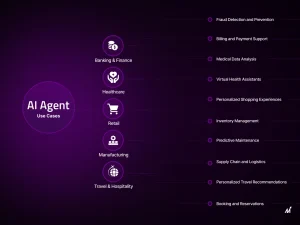
Image Source : https://markovate.com/
Education
In classrooms and online platforms, AI agents act as intelligent tutors. They analyze student performance, identify learning gaps, and adjust lesson difficulty in real time. Adaptive learning systems like these provide personalized feedback and ensure that each student learns at their own pace.
Corporate Operations
Within corporate ecosystems, AI agents streamline day-to-day workflows.Virtual assistants, for example, can manage a wide range of tasks. To begin with, they schedule meetings and organize calendars; in addition, they assist with document management, and furthermore, they handle HR-related queries efficiently.
Healthcare
Patient data analysis and diagnostics and medical data analysis .In the healthcare domain, predictive diagnostic agents play a vital role by first detecting early signs of diseases. Meanwhile, virtual health assistants continuously monitor patient recovery, provide timely updates, and furthermore, offer personalized advice to support better health outcomes.
Finance
In the financial sector, for instance, AI agents play a crucial role in algorithmic trading and fraud detection. To begin with, they continuously monitor transactions and market patterns; then, they act as vigilant analysts, quickly identifying suspicious or fraudulent activity within milliseconds. Moreover, they provide real-time risk assessments before transactions occur, thereby ensuring greater accuracy and security in financial operations. Transportation systems are undergoing a revolution through AI agents that enable self-driving vehicles, optimize logistics routes, and improve road safety.
Smart Cities
In fields like traffic management and energy optimization, AI agent systems play a key role in improving efficiency and innovation. These systems combine intelligent agents with real-time data to make smarter decisions. As a result, organizations can optimize resources, reduce delays, and respond quickly to changing conditions. This integration ultimately leads to smarter, more adaptable operations.
Specialized and Advanced AI Agent Concepts
Specialized and advanced AI agents, moreover, handle complex and domain-specific tasks with remarkable precision. By leveraging powerful AI agent tools such as TensorFlow Agents, LangChain, and OpenAI GPT, they not only analyze data efficiently but also adapt rapidly to changing environments. Consequently, these agents enhance automation, improve decision-making, and ultimately transform modern industries.
AI Agent-Based Multi-Agent Systems and Collaboration
In complex environments, multiple AI agents often collaborate or compete, forming what is known as multi-agent systems. Through constant interaction, they actively communicate, continuously coordinate, and efficiently share tasks. As a result, they work toward achieving broader and more dynamic objectives. Furthermore, this cooperation enhances overall system intelligence and adaptability.
For example, within the framework of AI agent architecture, applications such as swarm drones or distributed robotics demonstrate how agents actively collaborate. In these systems, they communicate continuously, share critical information, and coordinate their actions to maintain efficiency.
Ethical and Responsible AI Agent
As agents in AI become more autonomous, ensuring ethical design becomes vital. Developers must prioritize transparency, accountability, and fairness to maintain trust in AI-driven decisions.
Integration of AI Agent Architecture with Machine Learning
In the modern era, AI agent architecture now integrates deep learning, natural language processing, and reinforcement learning. As a result, it creates agents that can reason more effectively, adapt rapidly, and function much like humans. Moreover, this synergy of advanced technologies enables continuous improvement and smarter decision-making over time.
Final Thought: Are AI Agents Truly the Future of Technology?
The rise of agents in AI marks a pivotal shift toward intelligent, self-learning digital ecosystems. For students, they offer new career paths. For corporate officers, they unlock operational efficiency and for tech surfers, they reveal the limitless potential of automation.
So, are agents in AI the future of technology? Without a doubt, yes. However, their true potential does not lie merely in their intelligence or automation capabilities. Rather, it depends on how we shape, guide, and ethically apply them. Ultimately, by using AI agents responsibly, we can build a smarter, more connected, and more sustainable world.