Manual vs Automatic Cars in India: Which Is Best for Beginners?

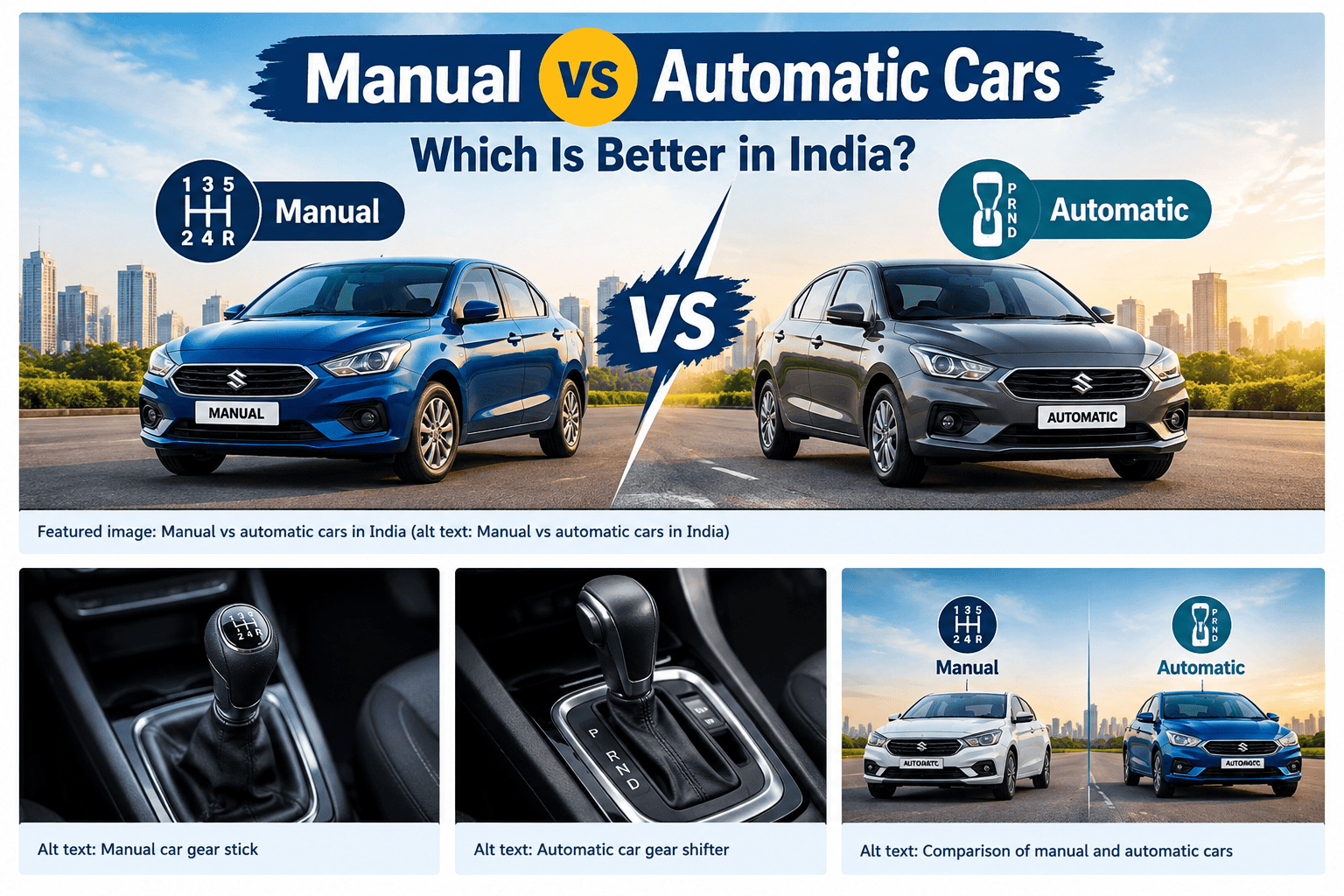
Choosing between manual vs automatic cars in India depends on your budget, driving habits, and personal preferences. Manual cars often appeal to drivers who want greater control, while automatic cars offer convenience in traffic. Before buying, compare mileage, maintenance costs, comfort, and long-term expenses to find the right option for your needs.Choosing between manual and automatic cars in India depends on your budget and driving needs. For beginners, the best cars for beginners in India offer easy handling and safety. Compare manual vs automatic mileage and manual vs automatic maintenance cost before buying. Automatic cars for new drivers are ideal for comfortable city driving.Buying your first car can be an exciting time, but if you’re trying to decide between a manual or automatic car, it can be difficult to know which to go with. Both vehicles have their own benefits and one is better than the other depending on the situation and budget. If you have to drive in busy city traffic, an automatic car will be better for you while a manual car could be a good choice for those who want more control of the vehicle and prefer a lower purchase price.
In India, where driving conditions and traffic differ from city to city, it’s important to understand the differences between the two before purchasing. In this manual vs automatic cars guide, we will compare driving comfort, mileage, maintenance cost and more to help you decide which vehicle is best for you
What Is A Manual Car?
A manual car refers to a vehicle in which the driver manually shifts gears by using a gear lever and a clutch pedal. The driver has to change gears depending on the speed they’re driving in and the road condition. A manual car is likely to be cheaper when buying in the first place.
Manual cars are preferred by a lot of drivers in india for several years now. They provide more control over gears which can come handy while driving on hilly terrains or in certain traffic conditions
But, for a beginner driver, it could take a while to master the technique of using a clutch and gear along with learning how to drive up an incline without the car rolling back
What Is an Automatic Car?
An automatic car is a motor vehicle fitted with an automatic transmission that allows the vehicle to change gears automatically, without requiring the driver to use a clutch pedal or engage a gear stick. The computer of the automatic car interprets the gas pedal or brake and the movement of the car and changes gears appropriately. Automatic cars are convenient for commuters because they reduce the amount of work for the driver, allowing them to relax while driving. It also makes finding a place to park easier, as well as allowing the driver to navigate through traffic with greater ease.
Automatic transmissions can be of different types: AMT, CVT, torque-converter automatic, and dual-clutch (DCT). These differences in automatic cars should be considered before purchasing a car, as they may have an effect on the driver’s comfort, performance, and fuel economy. Buying an automatic car is easier for novice drivers because it does not require extensive expertise like the driving of a manual car.
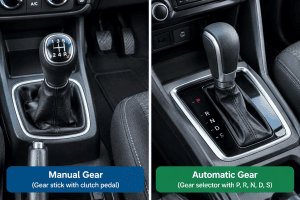
Manual vs Automatic Cars: 7 Vital Differences
Automatic and manual cars may have the same destination, but the road to get there is different in these vehicles. Here are the vital differences to consider before purchasing a car.
| Feature | Manual Car | Automatic Car |
| Gear changes | Driver changes gears | Transmission changes gears |
| Clutch pedal | present | Not present |
| Ease of learning | Requires practice | Generally easier for beginners |
| City traffic | Can be tiring | Usually more comfortable |
| Purchase price | Often lower | Often higher |
| Mileage | Can be efficient | Depends on transmission and model |
| Driving control | Direct control over gear selection | Gear selection managed automatically |
Maintenance Manual cars have regular clutch repair as they age automatic cars require certain transmission maintenance
Details will vary depending on the make, model, engine, transmission, and environment, so it’s a good idea to compare your options for the particular car you’re considering.
-
Driving Comfort manual vs automatic cars
Driving comfort is one of the significant differences between a stick shift and an automatic. To accelerate, with a manual gearbox one has to depress the clutch, shift gears, and release it again.. That’s usually easy enough on open roads, but can be extremely tiring to deal with in heavy traffic. Finding the best cars for beginners in India can be easy with proper research. The best cars for beginners in India offer safety, comfort, and simple controls. When choosing the best cars for beginners in India, compare mileage, price, and maintenance. The best cars for beginners in India should suit ybest cars for beginners in India our budget and driving needs.
An automatic removes this problem. The accelerator and brake work in conjunction without changing gears manually. This is a big plus for people living in metropolitan cities like Kolkata, Delhi, Mumbai, Bengaluru where they drive in traffic most of the time.
If you know you will be sitting in traffic most of the time, then automatic cars make a lot of sense to me. However, if you are going to drive mostly on open roads, the comfort of an automatic won’t be that important.
-
manual vs automatic cars Fuel Efficiency and Mileage
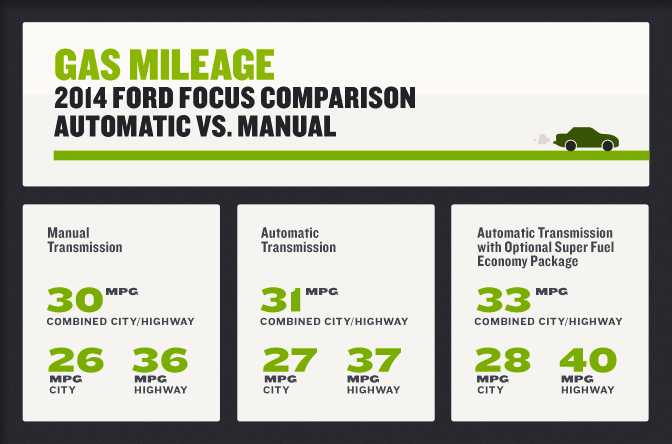
Mileage is a big consideration while buying a car.Most buyers automatically assume that a manual car will always give better fuel efficiency, but this isn’t the case.Some manual cars do offer excellent mileage,manual vs automatic mileage as you’ll be able to manually select the right gears. However, automatic transmissions are also capable of being highly efficient.
The final mileage is also going to depend on the engine, transmission, traffic, road conditions and driving patterns. Aggressive acceleration and braking will impact fuel efficiency of both a manual and automatic. Smooth Acceleration And Proper Tyre Pressure Helps To Achieve Good Mileage. manual vs automatic mileage Always compare the actual fuel efficiency of the specific variants of manual and automatic before buying.Official quoted mileage can often vary considerably from what you’ll get in real-world conditions.
-
manual vs automatic cars Purchase Price
The budget is always a huge consideration when you’re buying your first car. This is where manual versions of a car can often undercut automatics considerably.
The difference varies depending on the make and model, but purchasing a manual car will always give you a lower budget to choose from.
If you want the maximum trim or luxury options for your budget, a lower purchase price on a manual car might be your best option. While automatics do cost more, they can be worth it if you know you’ll be spending a lot of time in traffic.
Don’t just look at the purchase price – consider registration, insurance, fuel, and servicing costs as well. Some automatic cars might actually cost more to service than a manual, depending on the model.
-
manual vs automatic cars Maintenance Costs
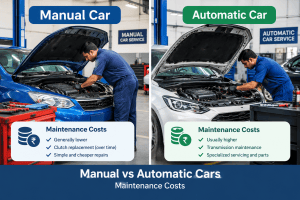
Maintenance manual automatic maintenance cost costs can vary significantly between a manual and automatic car.Manual cars have a clutch mechanism that wears out over time – especially if you spend a lot of time in traffic or use the clutch incorrectly. Worn-out clutches can add significantly to your maintenance budget.The manual automatic maintenance cost depends on the car model and driving habits. Comparing manual automatic maintenance cost helps buyers plan their budget. Generally, manual automatic maintenance cost may vary because of transmission repairs, servicing needs, and replacement parts, so consider long-term expenses before choosing your car.
Automatic cars have different transmission mechanism, and their maintenance costs depend on the type of automatic gearbox. Some automatic cars might require fluid changes and servicing according to the manufacturer’s schedule.It isn’t true that every manual car will be cheaper to maintain than an automatic. Repair cost varies with model and spare parts, so always visit an authorized service station to know the kind of servicing required for your car
-
manual vs automatic cars Performance and Driving Control
A manual car gives you full control over what gear you’re in. This can be useful in a variety of situations – driving on a steep hill, overtaking, or simply maintaining a gear on changing road conditions.
Many people also enjoy the driving experience of a manual car.
Automatic cars take over the task of selecting gears, but there are sport modes on most automatic cars that allow for manual gear selection. Different automatic transmissions (CVT, DCT, AT) have different performance characteristics. A CVT, for instance, will always prioritize smoothness of drive, while a DCT will always prioritize speed.
For everyday driving on ordinary roads, most automatic cars perform quite well. Beginners shouldn’t focus too much on the power of a car – smooth acceleration, visibility, and control are far more important. It isn’t always true that a car with one type of transmission will always be more powerful than another.
Pros and Cons of Manual Cars
Advantages of Manual Cars
- Lower purchase price
Manual variants of a car are always cheaper than automatic ones.
- Greater gearing control
You can select the gears you want to drive in.
- Excellent fuel efficiency
Some manual variants have excellent fuel efficiency.
- More familiar
Manual cars continue to be popular in India.
- More flexibility within budget
With a lower purchase price, you have more to spend on other trim levels and options.
Disadvantages of Manual Cars
- More effort in traffic
Constant clutch use and gear changes can be exhausting.
- Learning curve
A manual car isn’t intuitive – new drivers have to spend time learning to drive.
- Hill starts are tricky
New drivers will need to practice driving on hills to avoid rolling backwards.
- Clutches wear out
Improper use can damage the clutch mechanism.
Manual cars are a great option for buyers who want gearing control and lower purchase costs.
Pros and Cons of Automatic Cars
Advantages of Automatic Cars
- Easier to operate
There’s no clutch to manage.
- Comfortable in traffic
You won’t be required to change gears or use a clutch in traffic.
- Perfect for new drivers
Beginners don’t have to manage a clutch and gears at the same time.
- Smooth driving
Modern automatic transmissions are smooth and convenient.
- Less tiring for some drivers
Automatic cars are a great option for drivers stuck in heavy traffic.
Disadvantages of Automatic Cars
- Higher purchase price in most cases
Automatic variants are more expensive than manual ones.
- Higher repair costs
Some types of automatic transmissions can be very expensive to repair.
- Varying mileage
Automatic cars have a wide range of fuel efficiency.
- Varying driving characteristics
The driving performance is different due to different automatic transmissions available; test driving is necessary to choose yours.
Automatic cars are perfect for a relaxed drive and ideal for drivers who want to be comfortable while driving on the roads.
Which Is Better For New Drivers In India?
The choice between an manual vs automatic cars depends on your situation. If you live in a congested city and spend a lot of time in traffic, an automatic is clearly the better option. It will make driving much less tiring and more comfortable, and you’ll be able to reach your destination faster.
If you have a smaller budget, a manual car makes much more sense. It gives you greater control over the car while costing less. You also have more flexibility within your budget to purchase a better trim or more luxurious options.
Your requirements for the car also affect the choice between a manual and automatic If you’re going to be sitting in traffic most of the time, an automatic car is well worth the money. A manual, best cars for beginners in India though, may be better than an automatic if you plan on mostly driving on highways and wide open roads.
Test both types of car to see which one you prefer. Pay close attention to comfort and control – a car that offers you good visibility and smooth acceleration will always be a better option. Don’t forget, however, that an automatic car automatic cars for new drivers
isn’t a replacement for learning to drive. New drivers will need to take driving lessons and complete all formalities to obtain a license.
Manual vs Automatic Cars: Which Is Better for Long-Term Use?
When it comes to long-term car ownership, there isn’t a clear winner for all buyers. A manual car makes a lot of sense if you want to minimize your purchase costs and don’t mind controlling gears. An automatic car is a worthwhile investment if it makes driving more comfortable for you.
To compare the long-term costs of a manual and automatic, take a look at these factors:
- The difference in purchase price between the two variants
- Your average driving distance per month
- Fuel costs and expected mileage
- Servicing schedules and costs of both cars
- The length of time you expect to own the car
- The expected resale value of both manual and automatic
- The amount of time you spend in traffic
A person who drives a short manual automatic maintenance cost distance on smooth roads, for example,manual vs automatic cars will probably not benefit as much from an automatic transmission as someone who best cars for beginners in India drives two hours a day on heavy city traffic.
Always consider the costs associated with your decision before basing your decision solely on one factor.
Frequently Asked Questions (FAQs)
-
Are automatic cars better for beginners?
automatic cars for new drivers are much easier to learn for new drivers, since there is no clutch to manage. However, new drivers still require good training and practice.
-
Are manual vs automatic cars cheaper ?
In most cases, manual cars have a lower purchase price than automatic cars for new drivers. Always compare the purchase price between the two variants before buying.
-
Which car gives better mileage manual vs automatic cars?
Both types of transmission do not always give a better mileage. It actually depends on the engine, transmission, weight, traffic and driving pattern.
-
Is an automatic car good for Indian city traffic?
Yes – automatic cars for new drivers are much more convenient on congested city roads,manual vs automatic mileage since there is no clutch to manage or gears to change.
-
Are automatic cars more expensive to maintain?
Not always – it depends on the type of transmission and model. Compare fuel efficiency, servicing schedules, and repair costs before purchasing.
-
Should I learn to drive a manual car before buying an automatic?
No – you can learn to drive an automatic car as a beginner, as long as you get the formal training and practice. It isn’t necessary to learn to drive a manual car first.