

AI in Cybersecurity: Fighting Modern Cyber Risks

The growing complexity and speed of attacks require the use of AI in Cybersecurity to be one of the necessities in today’s world of digital security. The technology allows analyzing huge data, detecting any abnormalities, and responding to them much faster.
In the era of Artificial Intelligence Cybersecurity, it is not enough to have the knowledge about the topic at least in general for students, specialists, marketers, and even business personnel. Since it may be applied both for defending from the attack and for conducting the attack, it is vital to understand its advantages and disadvantages.
Why is the Importance of AI in Cybersecurity?
The traditional security measures need some hard coded rule or signature of the attack. But the hackers of today change their methods at a faster rate which makes it imperative to develop security mechanisms that can adapt themselves. AI in Cybersecurity uses data analysis and machine learning to detect patterns which escape the human eye.
Hence, the suspicious activity is detected early and investigation time is reduced.
Threat Detection with AI in Cybersecurity
The first benefit of using AI in cybersecurity is the faster threat detection. AI is capable of analyzing network traffic, login, devices, and applications in real-time.
For example, an employee logs into his company’s system from an unusual location and starts downloading lots of files. This behavior may be flagged by the AI system as suspicious, since it deviates from the pattern of the employee’s normal behavior.
Real-Time Response withArtificial Intelligence in Cybersecurity
In case of cyber attacks, even seconds matter. Just a few minutes can be critical during a theft of valuable information by the hackers.
With the help of AI technologies, any suspicious actions will be detected and reacted to. The connection will be stopped, the infected device will be isolated or security teams will be notified. That means that AI in Cybersecurity helps businesses take action before the minor issue becomes a serious breach.
Artificial Intelligence Cybersecurity and Fraud Prevention
Another field where AI can be very helpful is that of fraud prevention. Financial institutions, e-commerce businesses, and payment gateways can make use of artificial intelligence to analyze the transactions.
In case of a transaction which appears to be quite dissimilar to the pattern of behavior of a particular customer, it could be considered suspicious and analyzed further.
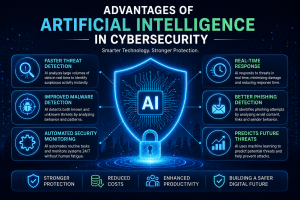
Advantages of Artificial Intelligence in Cybersecurity
The implementation of AI in Cybersecurity goes beyond just identifying the malware threats. This technology may also be used for the following purposes.
Threat Detection
It will be able to analyze large volumes of security data significantly faster than the human staff. It can spot the anomalies and highlight any potential threats in no time.
Malware Detection
Antivirus software detects the malware based on its signatures. In addition to that, artificial intelligence may examine the way the application works.
Thus, it will become possible to detect suspicious apps that do not have any malware signatures.
Automation of Security Monitoring
Security specialists get numerous alerts daily. Checking each of them manually requires lots of time.
Sorting out the alerts according to their priority, artificial intelligence will enable security experts to focus on urgent cases only.
Detection of Phishing Attacks
Phishing is one of the problems related to cybersecurity. It will be able to recognize phishing emails taking into account several criteria like email content, links, sender’s behavior, etc.
The Evolving Cybersecurity Threats: AI-Related Cybersecurity Threats
AI is not only a tool which helps organizations to protect themselves from cyber-attacks but it can also be used by attackers for improving their attacks. There is a number of AI-related cybersecurity threats which organizations have to be ready to fight against.
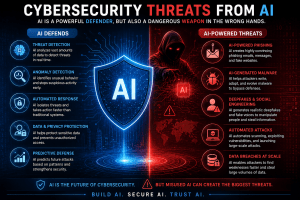
Phishing Using Generative AI
Phishing with generative AI means that attackers use the tools of artificial intelligence for creating phishing emails which will be characterized by improved grammar and increased levels of personalization comparing to common emails.
In such a way, the attacks will be more difficult for employees to detect. Organizations should provide reliable email protection as well as carry out regular training for employees.
Automated Attacks
Attackers might use AI to automate certain phases of their attack. It means that AI can help them to scan the target, find out vulnerabilities and make an attack customized.
Organizations have to be ready to react on such attacks in the same manner.
Deepfake and Social Engineering
Using AI technologies, attackers can generate images, videos and audio files. In this way, they can imitate employees, managers and any other people.
This problem is novel in relation to social engineering among organizational
AI-Based Solutions in Business Cybersecurity and Their Safe Use
First, companies should not consider AI technology as an ultimate substitute for the work of security professionals but combine them into a well-rounded security approach.
Develop AI Security Strategy
Prior to implementation of the technology, firms should determine their threats and select appropriate tools addressing them.
For instance, companies might want to implement AI for threat detection, endpoint protection, fraud detection, and identity protection.
Employee Training Programs
Even though technology could help prevent attacks, employees are also responsible for preventing security breaches. They should be aware of phishing emails, malicious links, suspicious payments and other social engineering techniques.
Control the AI System
Besides, firms should protect the system itself from being hacked. For example, attackers may try to manipulate the model or input false data into it.
Application of Specialized AI in Cybersecurity Concepts
With the advancement of AI technology, security experts are investigating other possible uses. Such concepts include behavioral analysis, automated incident response, anomaly detection, and AI-based security operation centers.
Use of Machine Learning in Cybersecurity
Machine learning helps the systems to learn from data and detect patterns. The systems do not depend on rule-based models alone and continue improving as they analyze more data.
It is, therefore, important in detecting abnormal behavior.
Use of AI in Zero-Trust Security
Zero-trust security means that no trust can be automatically extended to users and devices. Using AI, such an approach can be enhanced through constant analysis of identity, device behavior, location, and access behavior.
Through such analysis, a strong security system will be developed.
The Future of Artificial Intelligence Cybersecurity
The future of Artificial Intelligence Cybersecurity will definitely be characterized by increased automation and better cooperation between humans and AI.
Human experts will have to rely on AI assistants to investigate alerts, report on incidents, detect vulnerabilities, and suggest possible actions. Nevertheless, human intervention will be necessary because AI systems may make mistakes.
Conclusion: AI in Cybersecurity in the Future
AI in Cybersecurity is changing the face of threat detection, prevention, and response in organizations. This technology is able to perform fast data processing, identify suspicious activities, automate repetitive tasks, and speed up the decision-making process in terms of security issues.
At the same time, this technology may become a source of cyber risks through the creation of new types of AI. In other words, the hackers may start using this technology to enhance their attacks on people and companies.
The real power of this technology should be in its ethical use and reliance on humans for security purposes. Is the industry ready for such challenges?