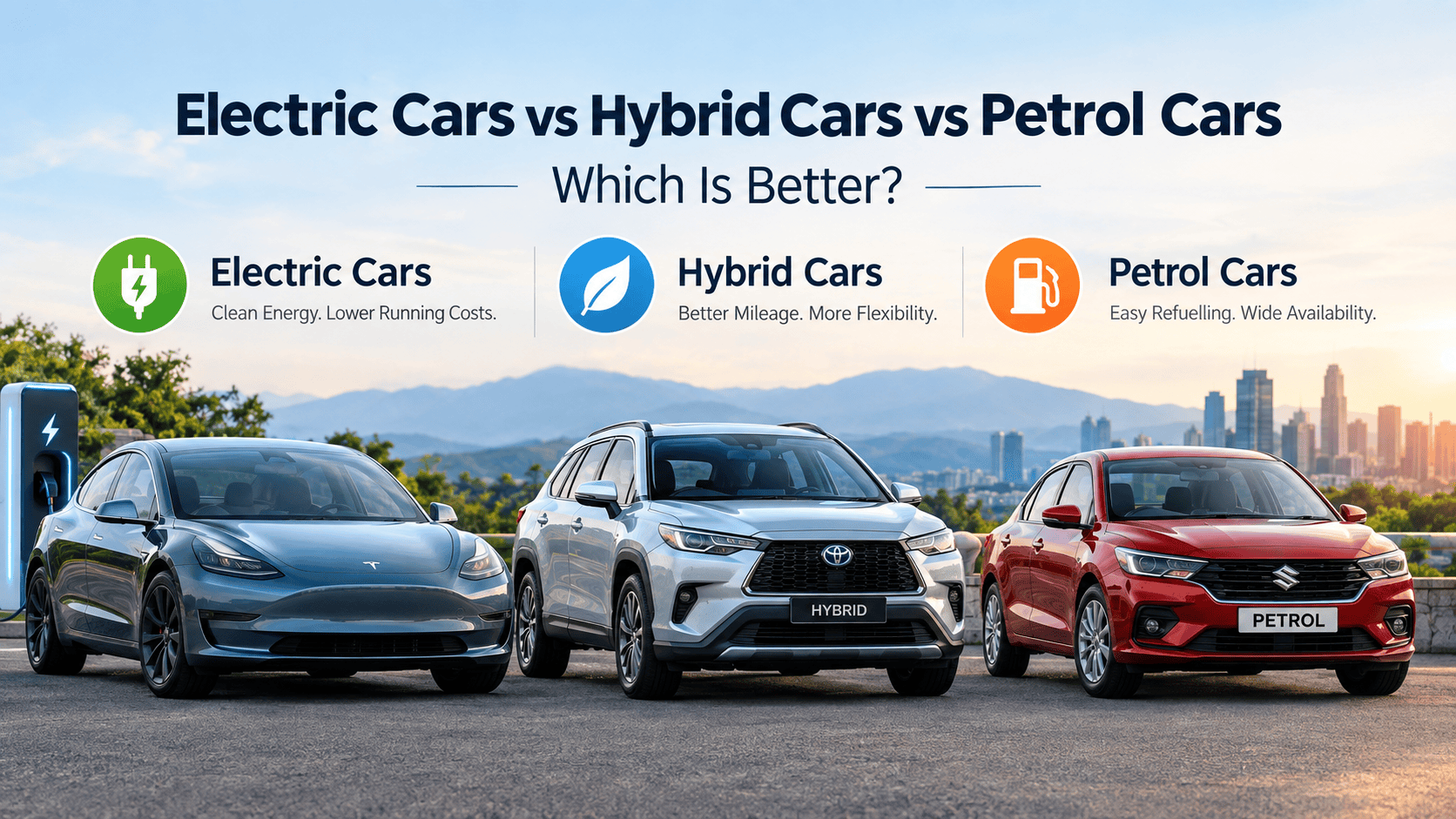
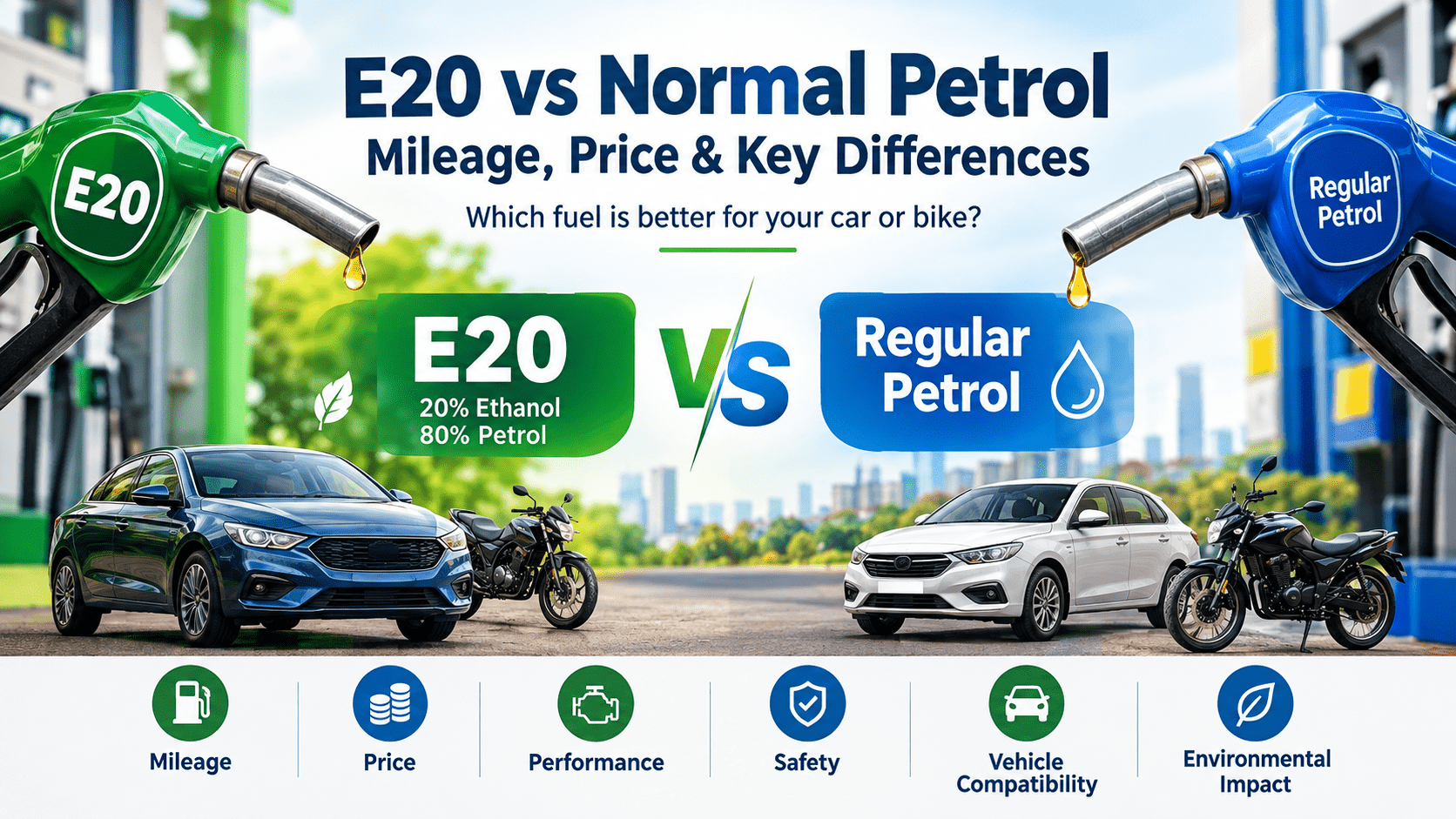
E20 vs Normal Petrol: Mileage, Price and Key Differences

The comparison between E20 and regular petrol is becoming increasingly important for car and motorcycle owners in India. With ethanol-blended petrol becoming more common, many vehicle owners are asking questions such as what is E20 fuel, does E20 reduce mileage, and is E20 safe for cars?
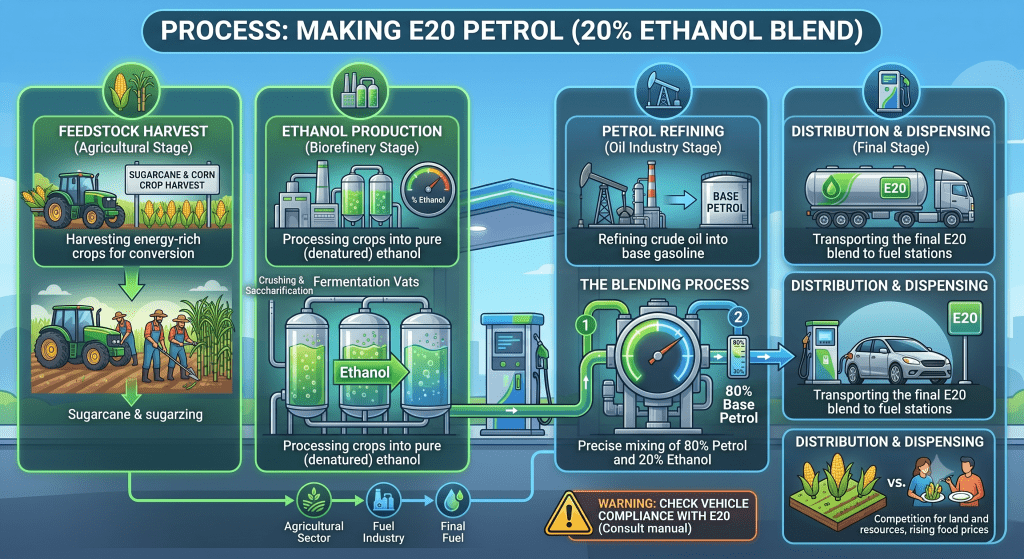
Ethanol-blended petrol contains 20% ethanol and 80% petrol. Ethanol can be produced from agricultural sources and can help reduce dependence on crude oil imports.
When comparing ethanol-blended petrol with normal petrol, several factors need to be considered, including mileage, fuel price, engine performance, compatibility, safety, and the age of the vehiclee.
What Is E20 Fuel?
E20 fuel is petrol blended with 20% ethanol and 80% petrol. The term “E20” refers to the ethanol content in the fuel.
What Is E20 Petrol?
Ethanol-blended petrol simply means petrol containing up to 20% ethanol. Ethanol can be produced from agricultural feed stocks, making ethanol blending part of India’s efforts to reduce dependence on imported crude oil.
India has been gradually moving towards higher ethanol blending in fuel. From April 2026, petrol sold in India is expected to contain 20% ethanol and have a minimum RON of 95, according to the information considered in this article.
E20 Fuel vs Regular Petrol: What Is the Difference?
The primary difference between E20 and regular petrol is the amount of ethanol present in the fuel.
Regular fuel with a lower ethanol blend contains a higher proportion of petroleum-based fuel. Ethanol-blended fuel, on the other hand, contains 20% ethanol.
Does Ethanol Affect Fuel Efficiency?
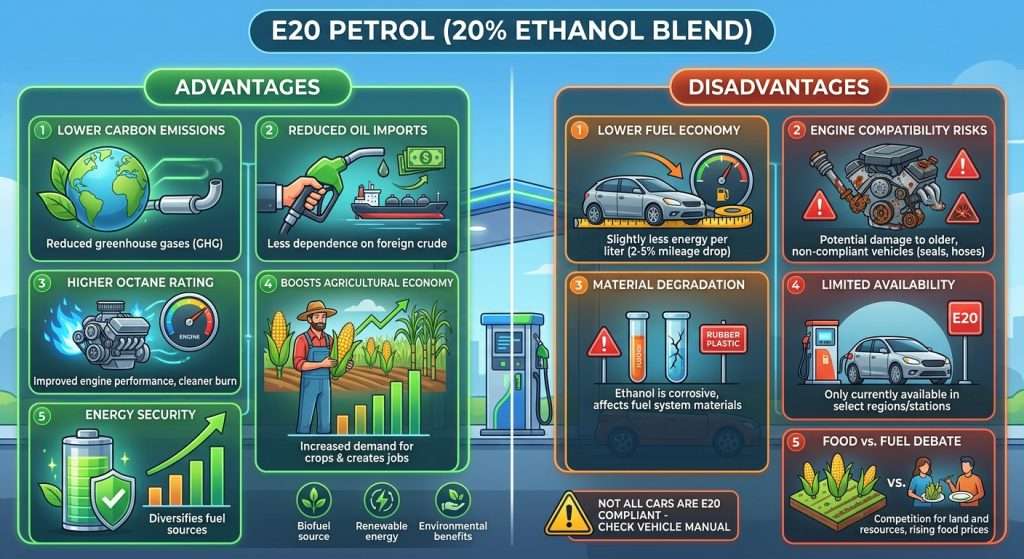
Ethanol contains less energy per liter than conventional petrol. As a result, some vehicles may deliver slightly lower fuel efficiency when running on E20 compared with lower-ethanol petrol.
However, the actual difference depends on the vehicle, engine technology, driving conditions, and driving habits.
E20 Petrol Mileage: Does E20 Give Lower Mileage?
Mileage is one of the biggest concerns among vehicle owners considering 20% ethanol-blended fuel.
Because ethanol has lower energy content per liter than petrol, an E20-compatible vehicle may deliver lower kilometers per liter compared with the same vehicle using lower-ethanol petrol.
However, the reduction is not identical for every vehicle.
What Affects E20 Mileage?
Several factors can influence the mileage you get from E20 fuel, including:
- Vehicle and engine design
- Driving style
- Traffic conditions
- Tire pressure
- Vehicle load
- Road conditions
- Air-conditioning usage
- Maintenance condition
- Fuel quality
E20 Petrol vs. Regular Petrol: Price, Mileage and Performance
When comparing ethanol-blended petrol with regular petrol, fuel price is only one consideration. Mileage, engine compatibility, performance, and long-term suitability are also important.
E20 Petrol Price vs. Regular Petrol Price
The price of E20 petrol cannot always be compared with a separate “regular petrol” price because ethanol-blended petrol has increasingly become part of the standard fuel supply in India.
Fuel prices can also vary depending on location, taxes, crude oil prices, and other market factors.
Therefore, simply comparing the pump price of ethanol-blended petrol with a hypothetical lower-ethanol petrol price may not provide a meaningful comparison.
E20 Fuel Performance
Ethanol has a higher octane rating than ordinary petrol. This characteristic can potentially benefit engines designed or tuned to take advantage of higher-octane fuel.
However, fuel performance ultimately depends on whether the vehicle’s engine and fuel system are designed for ethanol-blended petrol.
Testing of ethanol-blended fuel-compatible engines has considered areas such as:
- Engine durability
- Derivable ability
- Corrosion resistance
- Material compatibility
- Fuel-system performance
- Fuel economy
Are Cars in India Compatible With E20?
Many newer petrol vehicles sold in India are designed to use E20 fuel. However, compatibility depends on the vehicle manufacturer, engine, model, and manufacturing year.
How to Check if Your Car Supports E20
The most reliable way to check 20% ethanol-blended petrol compatibility is to consult:
- Your vehicle owner’s manual
- The manufacturer’s official information
- An authorized dealer or service centre
If you own an older fuel vehicle, checking compatibility before regularly using ethanol-blended fuel is particularly important.
E20-Compatible Vehicles in India
The Indian automobile industry has been preparing for the transition to higher ethanol blending in phases.
Manufacturers have been moving towards E20-compatible materials in vehicles, followed by vehicles that are specifically E20-tuned.
Do All New fuel Cars Support E20?
No. You should not assume that every petrol vehicle has exactly the same 20% ethanol petrol compatibility.
Compatibility depends on the specific vehicle and its engine. Always verify the recommendation for your particular model before making a decision about fuel.
E20 Fuel and Older Vehicles
Older petrol vehicles may have been designed to operate with lower levels of ethanol blending.
Ethanol has different chemical and material characteristics compared with conventional fuel. These characteristics can affect certain fuel-system components if the vehicle was not designed for higher ethanol blends.
Should Older Cars Use E20?
This does not necessarily mean that every older vehicle will immediately experience problems when exposed to ethanol-blended fuel.
However, owners of older vehicles should be more cautious and follow the fuel recommendation provided by the manufacturer.
If you are unsure whether your vehicle is compatible, contact the manufacturer or an authorized service centre for guidance.
Why Is India Moving Towards E20 Petrol?
India’s ethanol-blended fuel program has several objectives.
Reducing Dependence on Imported Crude Oil
Blending ethanol into fuel can reduce the amount of petroleum required for every liter of blended fuel. This can help reduce India’s dependence on imported crude oil.
Supporting Domestic Ethanol Production
Ethanol can be produced from agricultural sources. Increasing ethanol blending can therefore support domestic ethanol production and contribute to diversification of India’s fuel sources.
Supporting Energy Security
Greater use of domestically produced ethanol can contribute to India’s broader efforts toward energy security and reducing dependence on imported petroleum.
The transition to E20 has involved testing and consultation between government agencies, oil companies, automobile manufacturers, and other stakeholders.
E20 as an Alternative Fuel
Ethanol-blended fuel can play a role in diversifying India’s fuel sources and increasing the use of domestically produced ethanol.
Another potential advantage of ethanol is its relatively high octane rating. However, the most important factor is whether the engine is properly designed and calibrated to operate with E20.
Is E20 Bad for Your Car?
For an E20-compatible vehicle operated according to the manufacturer’s recommendations, E20 fuel is intended to be safe for regular use.
The situation can be different for older vehicles that were not designed for higher ethanol blends.
What Should Older Vehicle Owners Do?
If your vehicle does not meet ethanol-blended fuel requirements, do not make assumptions based only on general information about ethanol-blended fuel.
Instead:
- Check the owner’s manual.
- Follow the manufacturer’s fuel recommendation.
- Contact an authorized service centre if necessary.
- Check whether your specific model and year are ethanol-blended fuel-compatible.
Which Fuel Should You Choose?
There is no single answer that applies to every vehicle.
For E20-Compatible Cars and Motorcycles
If your new car or motorcycle is designed to operate on ethanol-blended fuel, there is generally little reason to avoid ethanol-blended fuel when it is the standard fuel available for your vehicle.
The vehicle is designed to operate with that fuel specification.
For Older Vehicles
For older vehicles, compatibility should be the first priority.
Rather than choosing fuel based only on mileage claims, check the manufacturer’s recommendation for your particular vehicle.
E20 vs Normal Petrol: Mileage Comparison
Ethanol-blended fuel may provide slightly lower mileage per liter in some vehicles because ethanol contains less energy per liter than conventional petrol.
However, this does not mean every vehicle will experience the same reduction.
Should You Test Mileage?
Yes. If you want to understand how E20 affects your vehicle’s mileage, compare fuel consumption over several tanks under reasonably similar driving conditions.
One tank is usually not enough to determine the actual mileage difference because traffic, driving behavior, road conditions, tyre pressure, and vehicle load can significantly affect fuel economy.
Final Thoughts: Is It Better Than Normal Petrol?
The E20 vs Normal fuel debate cannot be decided simply by asking which fuel provides more kilometers per liter.
Ethanol-blended fuel is part of India’s transition towards higher ethanol blending, with the broader objectives of reducing dependence on imported crude oil, supporting domestic ethanol production, and improving energy security.
For a vehicle that is designed and approved for E20, the fuel is intended to be part of normal daily operation.
For an older fuel vehicle, however, compatibility is more important than simply comparing mileage or fuel price.
Ultimately, instead of asking only “Which fuel gives better mileage?” the more important question is “Is my vehicle compatible with E20 fuel?”
Checking your owner’s manual and following the manufacturer’s recommendation is the safest and most reliable way to make that decision.