
US Green Card Suspension 2026: Microsoft, TCS, Infosys Among 8 Tech Firms Hit

The US green card suspension 2026 has placed eight major technology companies under fresh immigration restrictions. On October 8, the Trump administration and the US Department of Labor announced that Microsoft, Adobe, TCS, Infosys, Wipro and three other firms would face an indefinite suspension from a key employment-based green card process. The decision follows federal investigations into alleged misuse of US immigration programmes. For thousands of foreign technology professionals, particularly Indians working in the United States, US PERM suspension announcement raises an urgent question: What happens to their green card applications now?
The answer depends on an important distinction. The US government has suspended a labor certification process for certain employers. It has not announced a blanket ban on H-1B visas or canceled existing green cards.
What Is the US Green Card Suspension 2026?
The Trump administration has suspended eight technology and IT services companies from the Permanent Labor Certification program, commonly known as PERM. US Vice President JD Vance and Labor Secretary Keith Sonderling announced the decision on Thursday, October 8, 2026. The administration alleges that some companies misused immigration programmes to employ foreign workers while American workers faced layoffs or reduced job opportunities. Under the suspension, the US Department of Labor will stop accepting new PERM applications from the affected employers. It will also halt processing of their pending applications. Officials have not announced when the restrictions will end.
The decision forms part of a wider immigration enforcement campaign focused on foreign-worker recruitment and alleged employment-related fraud.
Which Eight Technology Companies Are Affected?
The US green card suspension 2026 covers eight major technology and outsourcing companies.
The companies named in the announcement are:
1. Microsoft — US-based technology company.
2. Adobe — US-based software company.
3. Tata Consultancy Services (TCS) — Indian IT services company.
4. Infosys — Indian multinational technology services company.
5. Wipro — Indian IT and consulting company.
6. HCLTech — Indian technology services company.
7. Cognizant — US-headquartered technology services company with substantial operations in India.
8. Capgemini — French multinational IT consulting company.
The inclusion of major Indian IT employers has raised concerns about the future of employment-based permanent residency applications.
These companies employ large international workforces and have long relied on skilled professionals across different countries. However, the restrictions specifically concern their participation in the PERM process. They do not automatically prevent these companies from employing all foreign nationals in the United States.
Why Did the Trump Administration Suspend These Companies?
The administration says the suspension aims to protect American jobs and investigate immigration rule violations. JD Vance singled out Microsoft, alleging it laid off thousands of US workers while filing numerous foreign-worker applications. Officials questioned whether employers genuinely lacked qualified American candidates, as required for PERM labor certification, and warned that misuse could disadvantage domestic workers. However, these allegations do not establish fraud by every company named. The investigations remain important to understanding the legal basis and future duration of the US green card suspension.
Microsoft Responds to US Visa Fraud Allegations
Microsoft has challenged the US PERM suspension and the administration’s portrayal of its immigration practices. In an official statement dated October 8, the company said it had submitted approximately 6,000 H-1B applications during the previous fiscal year. According to Microsoft, around 80% of these applications involved extensions or changes of status for existing employees rather than new recruitment. It also stated that the remaining applications involved individuals already legally present in the United States.
Microsoft said it pays comparable wages to H-1B employees and other workers performing similar roles. The response highlights a central dispute: Does the volume of visa applications demonstrate displacement of American workers, or does it largely reflect routine immigration processing for existing employees? That question requires evidence beyond the number of applications filed.
What Is PERM, and Why Does It Matter?
PERM is an important part of the US employment-based green card process. Before sponsoring a foreign worker for permanent residency in many employment-based categories, an employer must obtain labor certification from the US Department of Labor.
The process generally requires employers to:
• Identify a genuine, permanent job opportunity.
• Obtain the required prevailing wage determination.
• Conduct recruitment under applicable rules.
• Demonstrate that sufficient qualified US workers are not available.
• Show that hiring the foreign worker will not harm wages or working conditions for comparable American workers.
Once the employer receives certification, it can generally proceed with the relevant immigrant petition.
Therefore, a US PERM suspension can delay the initial stages of permanent residency sponsorship even when a foreign employee continues working legally in the country.
H-1B vs PERM: Are They the Same?
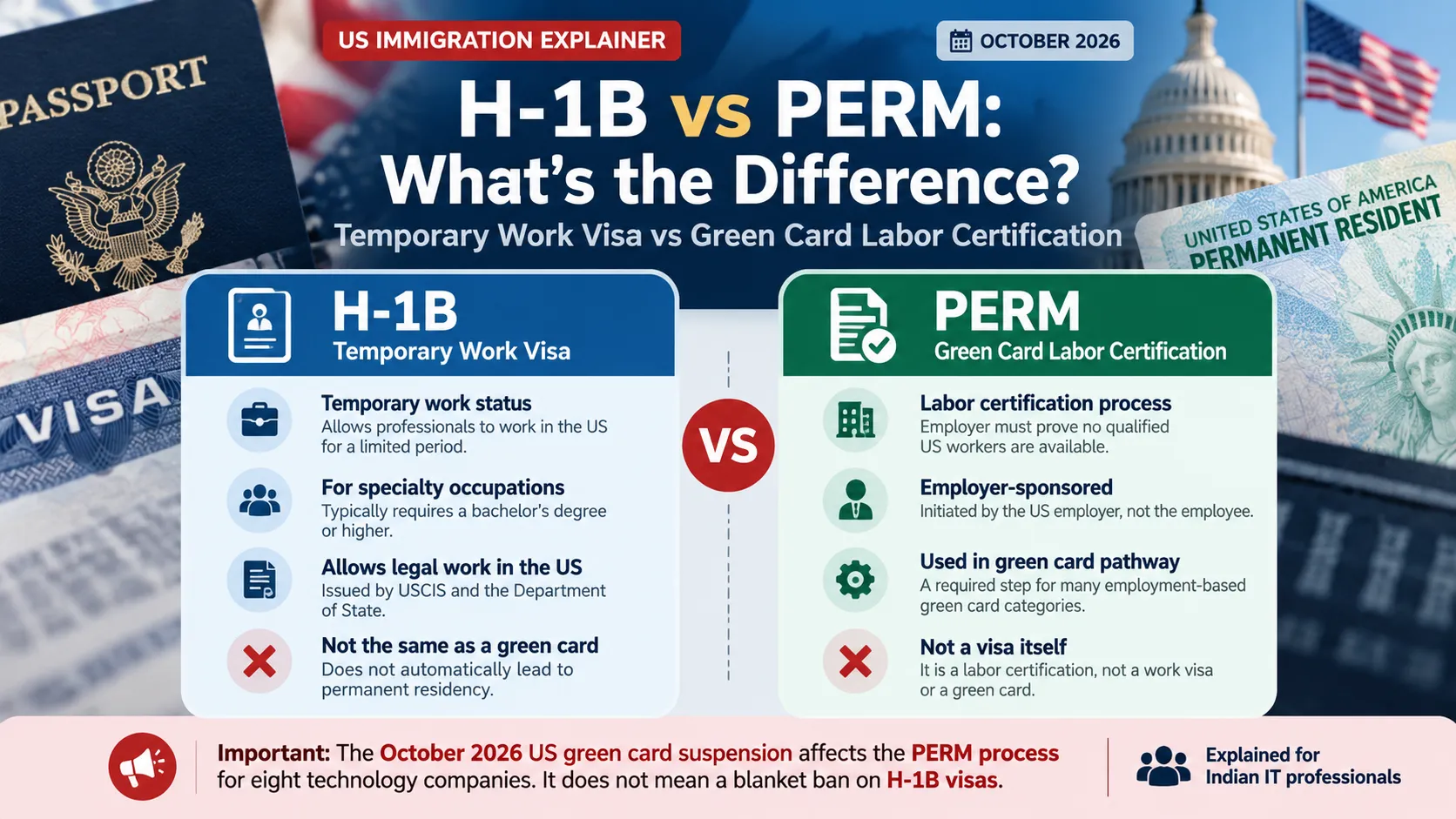
No. The two serve different purposes. An H-1B visa allows eligible foreign professionals to work temporarily in the United States in qualifying specialty occupations. PERM, by contrast, is a labor certification process that many employers must complete when sponsoring foreign workers for permanent residency. An H-1B visa does not automatically lead to a green card. Similarly, PERM certification does not itself grant a visa or permanent residency. The October 8, US PERM suspension action targets PERM processing for the eight named companies. Existing H-1B visas have not been automatically revoked by this announcement.
How Will the US Green Card Suspension 2026 Affect Indian Workers?
The US green card suspension could create serious uncertainty for Indian technology professionals who depend on employer-sponsored permanent residency.
However, the consequences will differ depending on the stage of each employee’s immigration application.
Employees Yet to Begin the Green Card Process
Workers whose employers have not filed PERM applications may face delays in starting the usual sponsorship process.
Without a new PERM filing, some employees may also have difficulty establishing the priority date needed for their employment-based immigration pathway.
Employees With Pending PERM Applications
The Department of Labor has reportedly stopped processing pending applications involving the suspended employers.
This could delay decisions for workers who have already completed substantial parts of the application process.
Employees With Approved PERM Certifications
The position of workers whose certifications have already received approval is less clear.
Authorities have not fully explained how existing certifications or subsequent immigrant petitions will be treated.
Employees should therefore avoid assuming that previously approved applications have automatically been canceled.
H-1B Workers Approaching Their Visa Limits
Some H-1B professionals may face additional difficulties if delays interfere with their long-term immigration plans.
Certain immigration provisions allow eligible workers to extend H-1B status beyond the usual six-year limit while pursuing permanent residency.
A prolonged PERM suspension could complicate those arrangements for some applicants.
Individual circumstances, filing dates and immigration eligibility will determine the actual impact.
What Does This Mean for TCS, Infosys and Wipro?
The US decision creates fresh challenges for Indian IT companies that operate across international markets. These businesses often move skilled employees between India and the United States to serve clients, manage projects and deliver technology services. The US green card suspension could complicate workforce planning and long-term retention of foreign professionals seeking permanent residency. It may also increase legal and compliance costs.
However, industry representatives argue that Indian technology companies have increasingly expanded local recruitment in the United States.
Indian IT industry association Nasscom has stressed the distinction between permanent immigration and the temporary movement of skilled professionals. The longer-term impact will depend on how the investigations develop and whether the government restores the affected companies’ ability to submit PERM applications.
US Also Investigates Universities Over J-1 Visas
The US Department of Labor and its crackdown extends beyond technology companies. The administration also announced investigations involving nine American universities, including Harvard, Yale and Stanford. Officials allege that certain institutions may have misused exchange visitor arrangements to employ international researchers at wages that could disadvantage American workers. The investigations involve the J-1 visa program, which is separate from PERM and H-1B.
Authorities have reported issuing subpoenas as part of the inquiries. As with the technology companies, the allegations must be distinguished from established findings of wrongdoing.
What Should Affected Indian Professionals Do about the US Green Card Suspension?
Employees working for the suspended companies should first identify the current status of their immigration applications.
Those with pending PERM filings can seek updates from their employers’ immigration teams.
Workers approaching H-1B expiration dates should review their eligibility for extensions with a qualified US immigration lawyer.
Employees should also preserve relevant application records, approval notices and employer correspondence.
Above all, they should rely on official government notifications rather than social media claims suggesting that every Indian technology worker faces immediate visa cancellation.
Final Thoughts: What Comes Next for the US Green Card Suspension 2026?
When the US Department of Labor announced US green card suspension 2026, it marked a significant escalation in the Trump administration’s scrutiny of employment-based immigration. For the eight affected companies, the immediate challenge involves disrupted PERM applications and growing regulatory uncertainty. For Indian professionals, the biggest concern is the potential delay in securing long-term residency.
Yet the distinction between temporary employment status and permanent residency remains essential. The investigations have not established that every company committed fraud, and the government has not announced a blanket cancellation of H-1B visas.
The next developments to watch are the findings of federal investigators, the companies’ responses and any official guidance on pending or previously approved applications. The larger question remains: Can the United States protect domestic employment opportunities while maintaining access to the international talent that supports its technology industry?