
What Is an IPO? A Simple Guide to Initial Public Offerings

When you hear that a company is “going public”, you may wonder what that actually means. You may have seen this term in the news or while checking the stock market.If you are new to investing, you may have searched what is an IPO, meanings of initial public offering meaning, or even define IPO.
Don’t worry, the idea is not as difficult as it sounds.

Initial Public Offering Meaning(IPO): Where It All Begins
IPO stands for Initial Public Offering. A private company uses an IPO when it wants to offer its shares to the public for the first time.
Before this happens, the company is usually owned by its founders, early investors and other shareholders. Regular investors can’t simply buy its shares from the stock market.What is an IPO meaning for new investors
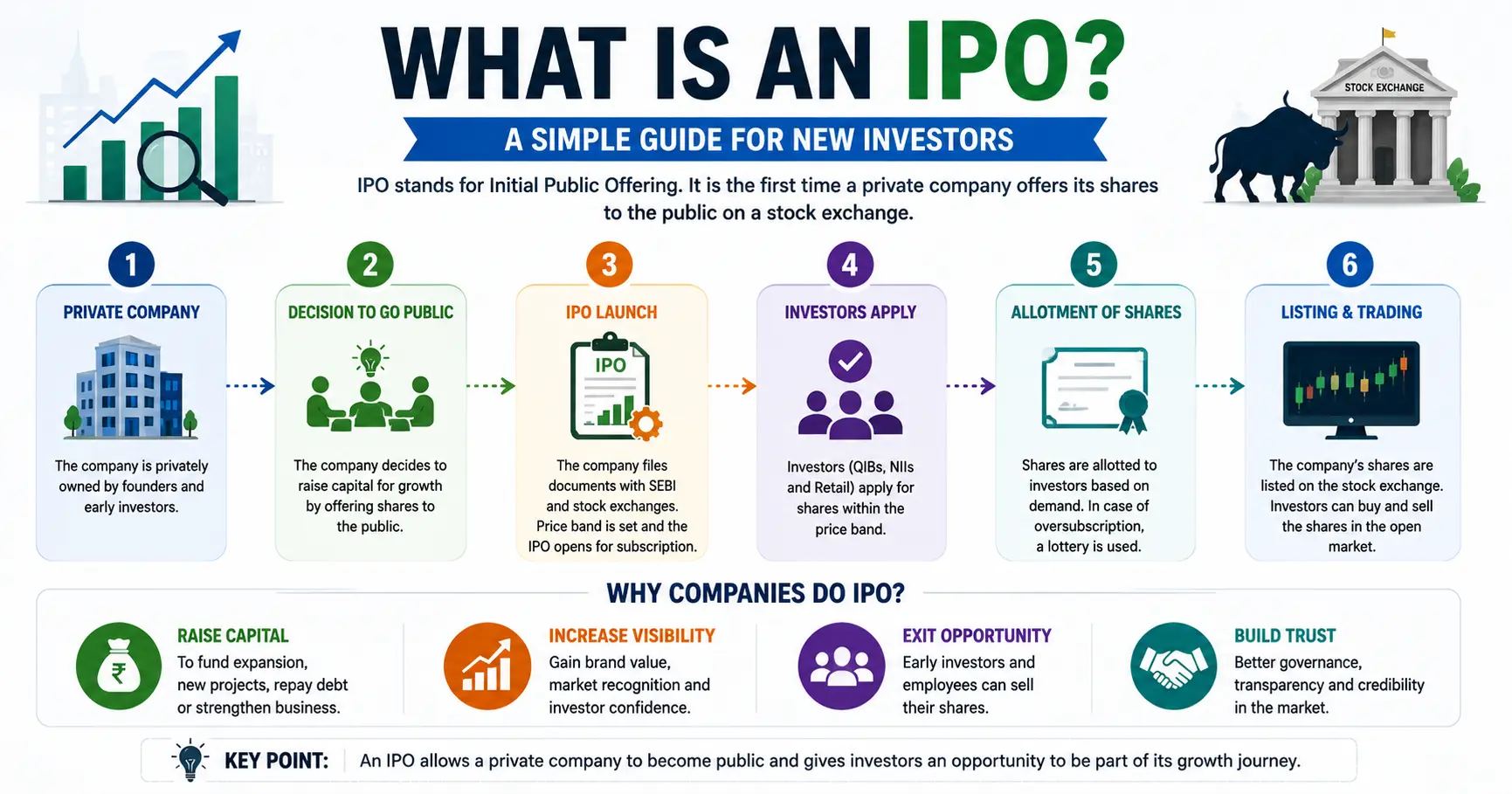
Things change after the IPO. The company’s shares can be listed on a stock exchange, and investors can then buy and sell those shares in the market.
So, if you are searching for the IPO meaning, this is the basic idea. A private company offers a part of its ownership to public investors and raises money by selling shares.
The initial public offering meaning is also easier to understand with an example.
Imagine a company that started with a small team. It did well over the years and now the business has become much bigger. The owners want to expand again, but they need a lot more money for it.
They could borrow from a bank. They could also get money from private investors. But going public is another option.
Through an IPO, the company can sell shares to investors and raise capital. In return, those investors get a small ownership in the company.
That’s basically what an IPO is.
Why Do Companies launch IPOs
There is usually a reason behind a company going public. It can be about raising money, giving early investors a way to sell their shares, or simply getting more attention in the market.Let’s look at the main reasons.
Raising Capital for Growth
Money is one of the biggest reasons companies launch an IPO.
A company can raise a large amount of capital from public investors through an Initial Public Offering. What it does with that money depends on its own plans.
It may use the funds to expand the business, open new facilities, develop new products or pay off existing debt.
For some businesses, an IPO can bring in much more funding than they could get from private investors alone.
That extra capital can then be used to take the business to its next stage.
Giving Early Investors an Exit Through an IPO
Before a company goes public, founders, employees and early investors may already own shares in it.
Some of them may have been holding those shares for years.
When the company launches an IPO, these shareholders may get an opportunity to sell some of their shares. This gives them a chance to turn part of their investment into actual cash.
So an IPO can be useful for the company, but it can also give early shareholders an exit.
Boosting Brand Visibility
There is another thing that happens when a company goes public. More people start noticing it.
The company may get coverage in the media, analysts may start following it and more investors may learn about the business.
This extra attention can be useful in other ways too. It may help the company attract new employees, business partners and customers.
How Does the IPO Process Actually Work?
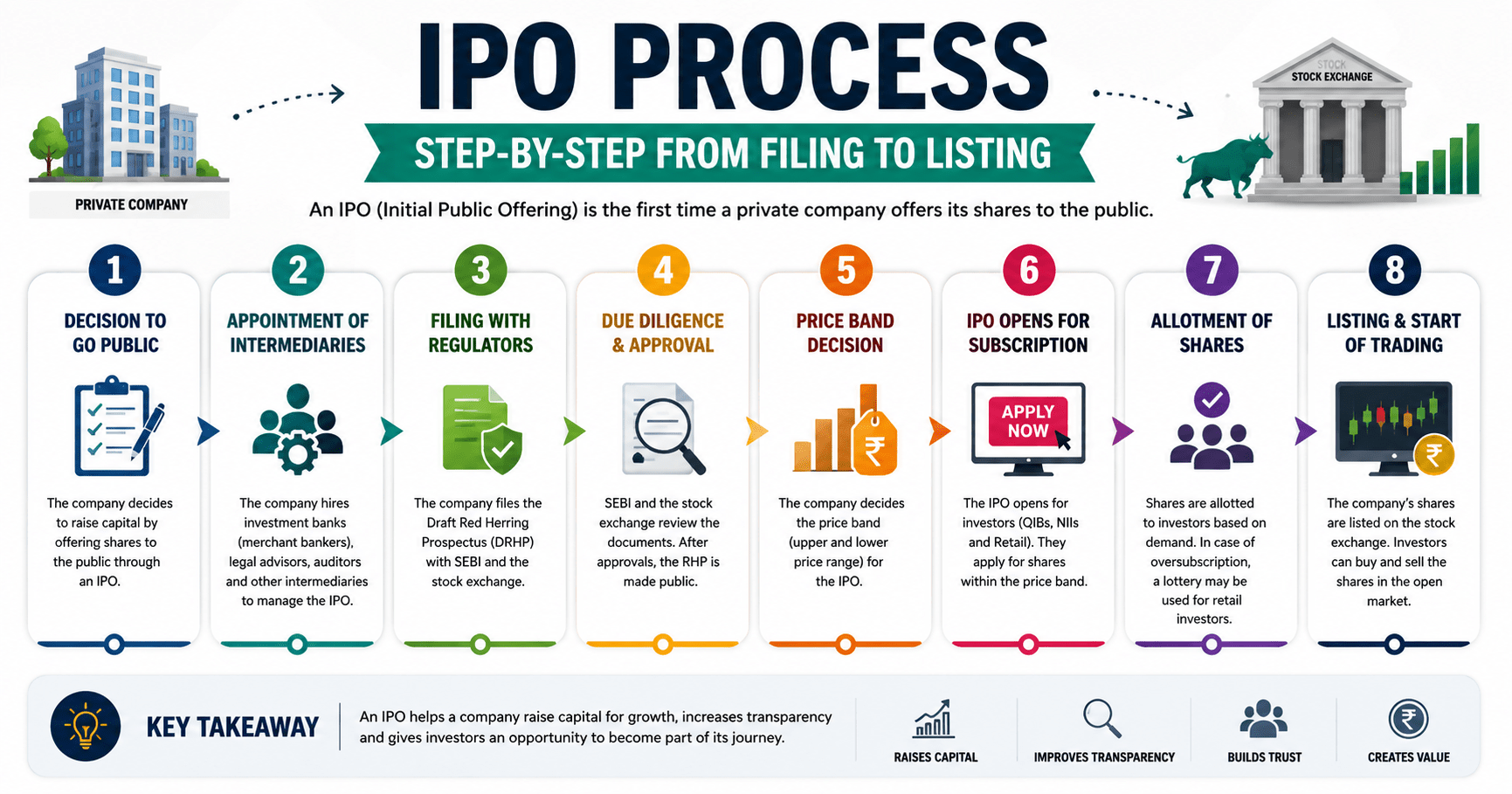
Knowing the IPO definition is a good start, but you may also want to know what happens before a company’s shares actually reach the stock market.
There are a few steps involved.
Hiring Investment Banks(IPO)
The company normally works with investment banks during the IPO process. These banks act as underwriters.
They help the company with things like deciding the share price, the number of shares to offer and how the IPO should be managed.
They can also help connect the company with institutional investors and retail investors.
So, the company doesn’t have to handle the whole process on its own.
Filing IPO Documents With Regulators
After that, the company has to submit detailed documents to the relevant securities regulator.
These documents contain information about the business. Investors can find details about the company’s financial performance, business, risks and future plans.
This part is important because people are going to invest their money in the company.
They need to have a proper idea about the business before deciding whether they want to invest or not.
Setting the Price Band
Next comes the price band.
A price band is simply a range within which investors can place their bids.
For example, suppose an IPO has a price band of ₹100 to ₹110. Investors can place their bids within this range.
The final issue price is decided after looking at the demand during the IPO.
Opening the Subscription Window
Now the IPO is open for investors.
Usually, investors get around two to three days to apply for the shares and submit their bids.
There are different categories of investors, including institutional investors, high-net-worth individuals and retail investors.
Each category has its own portion of the shares.
During this period, investors apply for the IPO and wait for the allotment.
Allotment and Listing
Once the subscription period ends, the allotment process starts.
Sometimes an IPO gets much more applications than the number of shares available. This is called an oversubscribed IPO.
For retail investors, a lottery system may be used when there are more applications than available shares.
After the allotment is completed, the company’s shares are listed on the stock exchange.
From that point, investors can buy and sell the shares in the open market.
Types of IPOs You Should Know
If you are learning about initial public offerings, you will come across a couple of different ways an IPO can be offered.
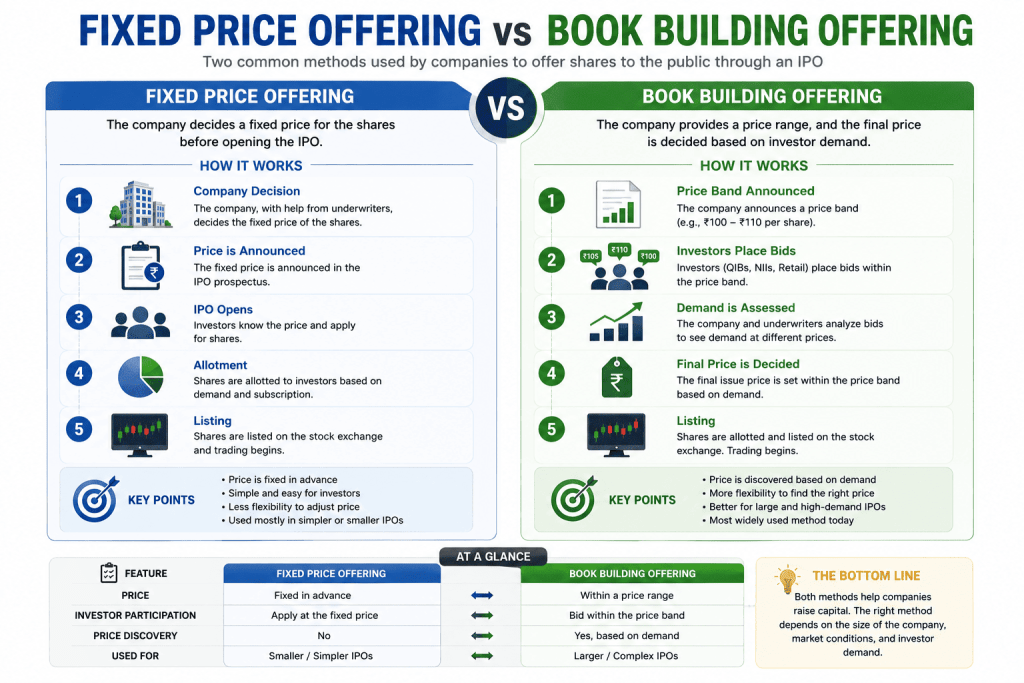
The two main types are fixed price offering and book building offering.
Fixed Price Offering
This one is fairly simple.
In a fixed price offering, the company decides the price of its shares before the IPO opens.
Investors already know how much they have to pay for the shares. There is no bidding process involved.
Book Building Offering
Book building works a little differently.
Instead of giving one fixed price, the company gives investors a price range.
Investors then place their bids within that range.
For example, if the price band is ₹100 to ₹110, an investor can place a bid within those prices.
Once the bidding is over, the final issue price is decided based on the demand received during the IPO.
Book building is the more common method used today.
Risks and Rewards of Investing An IPO
Understanding IPOs meaning is useful, but it doesn’t tell you whether an IPO is actually worth investing in.
Like other investments, IPOs can have both good and bad sides.
The Potential Upside
Some IPOs can give good gains on the listing day.
This can happen when there is strong demand for the shares and the gray market is showing a strong premium.
There can also be opportunities for investors who hold the shares for a longer period. If the company keeps growing after going public, the stock could benefit from that growth.
But there is no guarantee here.
An IPO that looks exciting today may not perform the same way after a few months or years.
The Real Risks
This is something new investors sometimes ignore.
A newly listed company doesn’t have a long public trading history. Because of this, its share price can move up and down quite quickly.
Valuation is another thing to think about.
Some companies may be priced very high during their IPO. If the company doesn’t grow as much as investors expected, the stock can perform badly for a long time.
So just because an IPO is getting a lot of attention, it doesn’t mean the shares will automatically go up.
Common Myths About IPOs
There are quite a few things people believe about IPOs, especially when a popular company is going public.
Some of them are simply not true.
Myth: All IPOs Are Guaranteed Profits
No, they aren’t.
Not every IPO gives investors a profit. Some stocks can even start trading below their issue price on the listing day.
So getting an allotment doesn’t mean you are guaranteed to make money.
There is no such thing as a guaranteed profit in an IPO.
Myth: You Need Huge Capital to Apply
You don’t need to be a big investor to apply for an IPO.
Retail investors can usually apply with a relatively small amount, depending on the lot size and issue price.
So, normal investors can also participate in initial public offerings.
What Should You Check Before Investing in an IPO?
Knowing the meaning of IPO is just the beginning if you are actually planning to invest.
You should also spend some time looking at the company itself.
Check its business and financial performance. Look at what the company plans to do with the money raised through the IPO.
It is also important to understand the risks.
Don’t apply just because everyone around you is talking about a particular IPO. Sometimes people get excited because they are expecting a big listing gain.
That alone is not a good reason to invest.
For example, you may see people searching for Shiprocket IPO or Shiprocket IPO allotment when that company becomes a hot topic among investors.
The same thing can happen with other upcoming IPOs. A lot of attention doesn’t always mean a good investment.
Take some time and do your own research first.
A Quick Look at IPOS
If you want to define IPO in one simple sentence, you can say that an IPO is the first time a private company offers its shares to the public.
Here are the main things to remember:
- IPO meaning: Initial Public Offering.
- A private company offers its shares to public investors.
- The company can raise capital through the IPO.
- Investors may receive shares through the allotment process.
- After listing, the shares can be traded on a stock exchange.
- IPOs can give good returns, but losses are also possible.
- Retail investors can also apply for many IPOs.
That’s the basic idea behind IPOs.
Final Thought: Should You Invest in the Next IPO?
So, what is an IPO really?
It is the process through which a private company offers its shares to the public for the first time. After the process, the company’s shares can be listed on a stock exchange and traded by investors.
Hopefully, this guide has made IPO meaning, IPO definition, initial public offering meaning, meaning of IPO, and IPOs meaning easier to understand.
Initial public offerings can give investors an opportunity to invest in a company’s public journey. But that doesn’t mean every IPO will be a good investment.
Before applying, take a little time to understand the company. Look at its business, financials, future plans and the risks involved.
Don’t apply just because everyone is talking about it. And don’t assume that a high gray market premium means guaranteed profit.
Take a step back, do your own research and then decide.
An IPO can be a good opportunity, but it can also bring losses if you don’t understand what you are investing in.