
Introduction on machine learning : what , how and why its matter

Machine Learning Explained: What It Is, How It Works, and Why It Matters
SEO Title: Machine Learning Explained: What Is Machine Learning, and How Does It Work?
Meta Description: What is machine learning? Learn how machine learning works, its main types, supervised learning, ML algorithms, and how deep learning is changing technology.
Suggested URL:
/what-is-machine-learning
Machine Learning Explained: What Is It and How Does It Work?
You have probably heard the term “machine learning” many times. It appears in conversations about artificial intelligence, smartphones, social media, online shopping, and even self-driving cars.
But what does machine learning actually mean?
At first, it can sound like a complicated computer science topic. The basic idea, however, is easier to understand than you might think.
Instead of giving a computer instructions for every single situation, machine learning allows a computer to learn patterns from data and use those patterns to make predictions or decisions.
In simple words, machine learning helps computers learn from experience and data rather than relying only on fixed instructions.
What Is Machine Learning?
So, what is machine learning?
Machine learning is a branch of artificial intelligence that allows computer systems to learn from data and improve their performance on a task without being explicitly programmed for every possible situation.
For example, think about your email inbox.
You may notice that some emails automatically go into your spam folder. The system can learn from patterns in emails and identify messages that are likely to be unwanted.
Another simple example is Netflix or YouTube recommendations. When you watch certain types of videos or shows, the platform can use that information to suggest similar content.
That’s machine learning working in the background.
How Does Machine Learning Work?
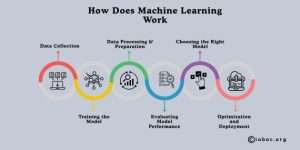
The process can sound complicated, but let’s use a simple example.
Imagine you want a computer to recognize pictures of cats.
You could give the system thousands of pictures, some showing cats and some showing other animals.
The machine learning model studies the data and looks for patterns.
Over time, it may learn that certain combinations of shapes, features, and patterns are commonly found in pictures of cats.
When you give it a new picture, it can use what it learned to make a prediction.
It won’t necessarily be correct every time, but with good data and a suitable model, its performance can improve.
Why Is Data So Important?
Data is one of the most important parts of machine learning.
A machine learning system learns patterns from the information it receives. If the data is poor, incomplete, or contains mistakes, the results can also be unreliable.
For example, imagine training a system to recognize different types of fruit, but most of the training pictures show only one type of apple.
The system may struggle when it sees different varieties or unusual examples.
This is why collecting, preparing, and checking data is such an important part of machine learning.
Types of Machine Learning
There are several types of machine learning, but three commonly discussed categories are
- Supervised learning
- Unsupervised learning
- Reinforcement learning
Each one works differently depending on the type of problem being solved.
What Is Supervised Learning?
Supervised learning is a type of machine learning where the model learns from labeled data.
That means the training data already contains the correct answers.
For example, suppose you want to train a model to identify whether an email is spam.
You could provide many emails that are already labeled:
Spam
or
Not Spam
The model studies the examples and learns patterns associated with each category.
Later, when it receives a new email, it can use those patterns to predict whether the email is likely to be spam.
Supervised learning is commonly used for tasks such as classification and prediction.
What Is Unsupervised Learning?
Unsupervised learning works differently.
Here, the data does not have predefined labels.
Instead, the machine learning system tries to find patterns or groups within the data on its own.
For example, imagine an online store has information about thousands of customers but doesn’t know exactly what types of shoppers they are.
An unsupervised learning system could identify groups of customers with similar shopping behavior.
The business could then use those groups to understand its customers better.
What Is Reinforcement Learning?
Reinforcement learning is based on learning through actions and feedback.
A system takes an action and receives feedback based on the result.
You can think of it like learning to play a game.
If the system makes a good move, it receives a positive reward. If it makes a poor move, it receives a negative reward.
By repeating the process, the system can learn which actions are more useful for achieving its goal.
Reinforcement learning has been used in areas such as robotics, games, and decision-making systems.
What Are ML Algorithms?
You may also come across the term “ML algorithms” when learning about machine learning.
An algorithm is basically a method or set of rules used to solve a problem or learn patterns from data.
Different problems require different algorithms.
Some commonly discussed machine learning algorithms include
- Linear regression
- Logistic regression
- Decision trees
- Random forests
- Support vector machines
- K-means clustering
- Neural networks
You don’t need to understand all of these immediately.
If you’re new to machine learning, it’s better to first understand the basic idea of how models learn from data before getting into the mathematics behind individual algorithms.
Machine Learning vs. Artificial Intelligence
Machine learning and artificial intelligence are related, but they are not exactly the same thing.
Artificial intelligence is the broader concept of creating systems that can perform tasks associated with human intelligence.
Machine learning is one approach used to build AI systems.
A simple way to remember it is
AI is the bigger field. Machine learning is one part of AI.
This is why the two terms are often used together.
Machine Learning and Deep Learning
You may have also heard about deep learning.
Deep learning is a more specialized area of machine learning that uses neural networks with multiple layers.
It has become particularly useful for working with large and complex datasets.
Deep learning is used in areas such as
- Image recognition
- Speech recognition
- Natural language processing
- Computer vision
- Generative AI
For example, systems that can recognize objects in photographs or understand spoken language can use deep learning techniques.
So, while deep learning is part of the larger machine learning field, the two terms should not be treated as exactly the same thing.
Where Is Machine Learning Used?
Machine learning is already being used in many everyday technologies.
Online Shopping
Shopping websites can use machine learning to recommend products based on browsing and purchasing behavior.
Social Media
Social platforms can use machine learning to decide which posts, videos, or advertisements may be relevant to users.
Healthcare
Machine learning can assist with analyzing medical information and identifying patterns in certain types of data.
Banking
Banks and financial companies can use machine learning to detect unusual transactions and identify potential fraud.
Transportation
Machine learning can be used in areas such as traffic prediction, route planning, and vehicle technology.
These are just a few examples. The technology is being explored and used across many different industries.
Is Machine Learning Difficult to Learn?
If you’re a beginner, machine learning can look intimidating because you may see programming, statistics, mathematics, and technical terminology everywhere.
But you don’t have to learn everything at once.
If you’re interested in learning machine learning, start with the basics.
First understand:
- What machine learning is
- How data is used
- The main types of machine learning
- What a model is
- How training works
- What algorithms do
After that, you can gradually move into Python, statistics, mathematics, and more advanced topics.
Taking things step by step makes the subject much easier to understand.
Why Should Students Learn Machine Learning?
Machine learning is becoming an important technology across many industries.
You don’t necessarily need to become a machine learning engineer to benefit from understanding it.
Even students studying business, marketing, finance, design, or other fields can benefit from knowing the basics.
For example, a digital marketer might encounter machine learning through advertising platforms, recommendation systems, customer analytics, or search technology.
Understanding the technology can help you see how modern digital tools work behind the scenes.
What Does the Future Look Like?
Machine learning will likely continue developing as computers become more powerful and organizations collect and process more data.
We are already seeing machine learning being combined with other technologies, including generative AI, robotics, and automation.
At the same time, there are challenges to consider.
Poor-quality data can lead to poor results. Models can also produce incorrect predictions, and questions around privacy, security, and responsible use are becoming increasingly important.
So learning machine learning is not only about understanding what the technology can do. It is also about understanding its limitations.
Conclusion
Machine learning may sound like a complicated subject, but the basic idea is quite simple: machines can learn patterns from data and use those patterns to make predictions or decisions.
From recommendation systems and spam filters to healthcare and fraud detection, machine learning is already part of many technologies we use every day.
If you’re just starting learning machine learning, don’t worry about understanding everything immediately. Begin with the basics, explore the different types of machine learning, and gradually learn about algorithms and programming.
Once you understand the foundation, topics like deep learning, neural networks, and more advanced ML algorithms become much easier to understand.
The technology is developing quickly, and having a basic understanding of machine learning can be a useful skill for anyone interested in the future of technology.