Artificial Intelligence and Job Loss

Artificial Intelligence and Job Loss: Will AI Replace Jobs?
A few years ago, artificial intelligence felt like something from a science-fiction movie. Today, it is already around us.
We use AI for many things without even thinking about it. It can help us write emails, create pictures, translate languages, answer questions, recommend videos, and even help businesses analyze their data.
But as AI becomes more powerful, one question has started to worry a lot of people:
Will AI take away our jobs?
It is a fair question. If a computer can do a task faster and sometimes cheaper than a person, companies may naturally want to use that technology. At the same time, the effect of AI on jobs is not as simple as saying that humans will lose their jobs and machines will take over.
Some jobs may change. Some tasks may disappear. And new types of work may also appear.
Why Are People Worried About AI and Jobs?
The concern about artificial intelligence and job loss comes mainly from the fact that AI can now perform many tasks that used to require human workers.
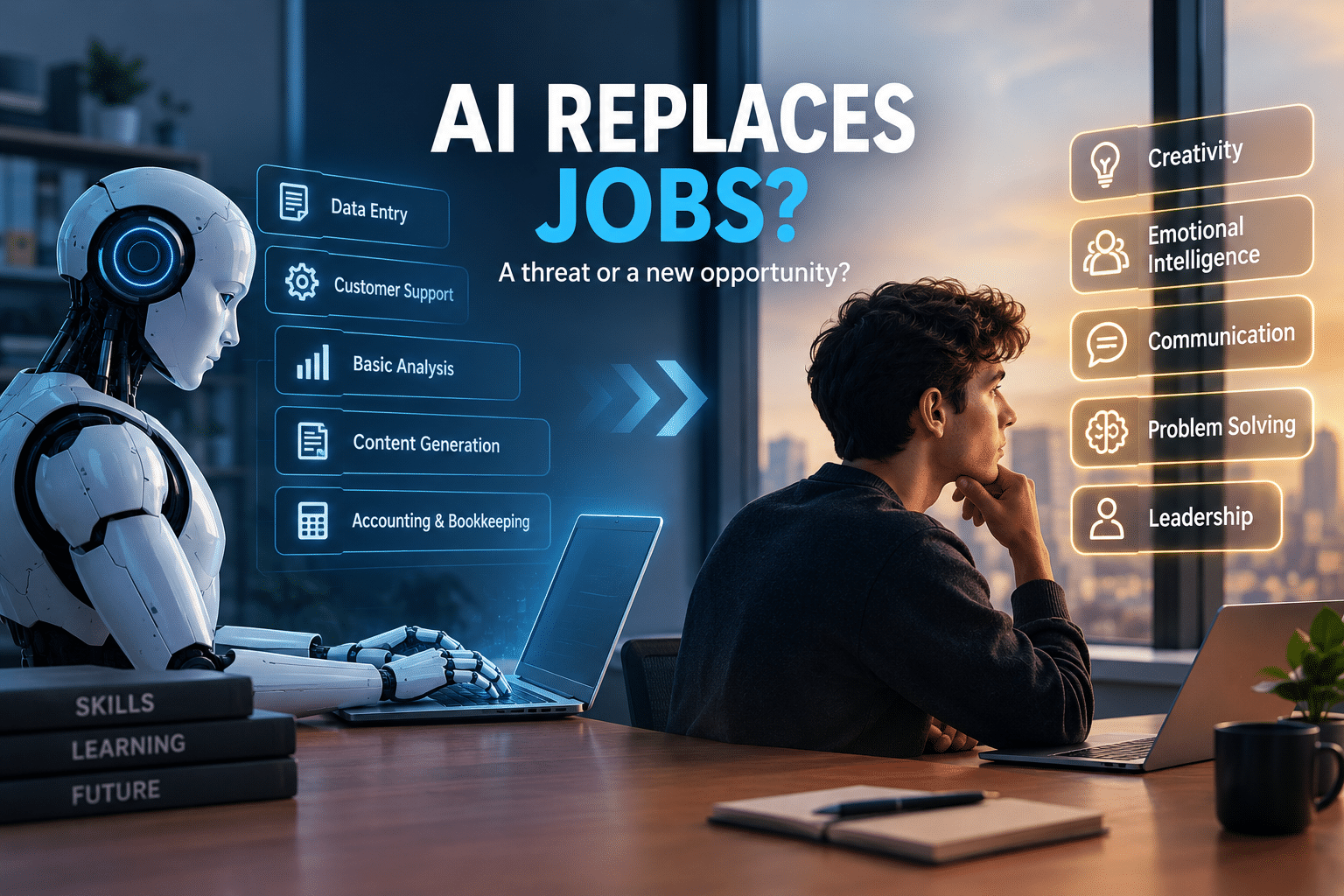
For example, AI can help with data entry, basic customer questions, writing simple content, analyzing information, and handling repetitive office work.
Imagine an employee spending several hours every day entering information into a spreadsheet. If an AI system can complete the same task in a few minutes, the company may no longer need someone to spend their entire day doing it.
This is where AI job displacement becomes a concern.
However, there is an important difference between AI replacing a task and AI replacing an entire job.
AI May Replace Tasks, Not Always Entire Jobs
Most jobs are made up of many different tasks.
Take a digital marketing job as an example. A marketer might research keywords, write content, manage social media, check campaign performance, communicate with clients, and create strategies.
AI can help with some of these activities.
It can suggest keywords, generate content ideas, analyze data, and help write advertisements. But the marketer still needs to understand the audience, make decisions, communicate with clients, and decide what strategy makes sense.
So instead of completely replacing the person, AI can change the way that person works.
This is something we are likely to see more often as AI develops.
What Jobs Will AI Replace?
When people search for what jobs AI will replace, they often expect a simple list of professions.
But there is no definite list of jobs that AI will completely eliminate.
Jobs that involve repetitive, predictable tasks may be more exposed to automation. These could include certain types of:
- Data entry
- Basic administrative work
- Routine customer service
- Simple document processing
- Repetitive content creation
- Basic information processing
Even in these areas, though, the situation can be different from one company to another.
A company might use AI to automate part of a job while keeping employees to handle more difficult tasks.
That is why talking about jobs AI will replace is more complicated than it first appears.
Is AI Actually Taking Over Jobs?
The phrase “artificial intelligence taking over jobs” sounds quite scary.
But technology has changed the workplace many times before.
Computers changed the way offices worked. The internet changed the way companies communicate and sell products. Machines have also automated many repetitive tasks in factories.
These changes did not simply mean that all human workers disappeared. Instead, the nature of many jobs changed.
AI could follow a similar path.
Some work may become automated, but people may also move into different roles that require skills that machines cannot easily provide.
New Jobs Can Come With New Technology
When we talk about AI and employment, it is easy to focus only on jobs that could disappear.
But there is another side to the story.
As companies start using AI, they need people who understand how these systems work and how to use them properly.
This can create opportunities in areas such as
- AI development
- Data analysis
- AI marketing
- Automation
- Cyber-security
- AI system management
- Technology support
Even existing jobs can start requiring AI-related skills.
For example, a marketer who knows how to use AI for SEO, content research, advertising, and data analysis may be able to handle some tasks more efficiently than before.
How Many Jobs Will AI Replace by 2050?
One question that gets a lot of attention is how many jobs AI will replace by 2050.
The honest answer is that nobody knows the exact number.
There are too many things that can change between now and 2050. AI technology itself will continue to develop, businesses will adopt it at different speeds, and new industries may appear.
Government rules, economic conditions, and people’s attitudes toward AI can also influence how quickly companies automate their work.
So, instead of trying to predict one exact number, it makes more sense to think about how different types of work could change.
Some Human Skills Are Difficult to Replace
AI is very good at processing information and completing certain repetitive tasks. But there are still many things where human abilities are extremely important.
Communication is one example.
Imagine a customer is extremely unhappy with a product. An AI chatbot can provide a response, but dealing with a complicated or emotional situation may require patience, understanding, and human judgment.
The same applies to leadership, creativity, teamwork, negotiation, and decision-making.
These skills can become even more valuable as AI handles more routine work.
Should Students Be Worried?
If you are a student thinking about your future career, it is normal to wonder how AI might affect your plans.
But I don’t think the answer is to avoid technology.
Instead, learning how to use AI can be a useful advantage.
For example, someone studying digital marketing can learn how to use AI for:
- Keyword research
- SEO
- Content ideas
- Social media planning
- Email marketing
- Advertising
- Data analysis
At the same time, it is important to build skills that AI cannot easily replace, such as communication, creativity, critical thinking, and problem-solving.
Having both types of skills can make a person more adaptable.
The Future May Be Humans and AI Working Together
It is easy to imagine the future as humans competing against machines.
But another possibility is much more practical: humans and AI working together.
AI could handle repetitive tasks while people focus on planning, creativity, communication, and important decisions.
For example, a business owner could use AI to analyze sales data and identify patterns. The owner could then use that information to decide what products to promote or what changes the business should make.
The AI provides assistance, but the human makes the final decision.
What Should We Learn From This?
The biggest lesson may be that learning should not stop when technology changes.
The skills that are useful today may not be exactly the same skills that are most valuable in ten or twenty years.
People who are willing to learn new tools and adapt to new ways of working may find it easier to keep up with these changes.
Instead of asking only “Will AI replace jobs?” we should also ask:
“How can I use AI to become better at my work?”
That question can lead to a much more useful conversation about the future.
Conclusion
AI is definitely going to change the world of work. Some repetitive tasks will probably become automated, and certain jobs may be affected by AI more than others.
At the same time, it would be difficult to predict exactly which jobs AI will replace or how many positions will disappear.
There will also be new opportunities as businesses find new ways to use artificial intelligence.
For students and working professionals, the best approach is to keep learning. Understanding AI, while also developing human skills such as communication, creativity, and critical thinking, can help people adapt to a changing workplace.
AI may change the way we work, but the future of jobs is not simply about AI replacing humans. It is also about humans learning how to work with AI.