Big Data Explained: What Is Big Data & How It Works

In today’s digital world, organizations generate massive amounts of information every second. Big data becomes important in this situation. If you frequently wonder what is big data, it refers to incredibly large datasets that are difficult for conventional data processing tools to handle. Indian companies, governments, and startups use data analytics to make decision with the help of technologies like Hadoop, map reduce, and modern data architecture, businesses can quickly and easily process complex information.
It enables businesses to identify trends and enhance services, from traffic monitoring systems to online shopping behavior. However, to know what is big data we need to explore its structure, technologies and applications. This guide will help you understand characteristic of big data, different types of data, and the technologies that power modern data systems.
What Is Big Data?
It is a set of large amount of data that is hard for previous systems to process. If someone want to know what is big data, it is simply data collected from various sources like social media, online transactions, mobile apps, etc. Also, companies use data analytics to process data and find patterns, trends, and valuable information.
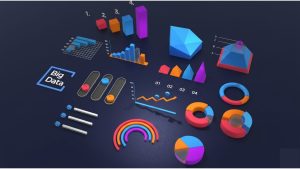
The process of how data analytics works have several steps. The first step is to collect data using various systems. Then, data is stored using various data processing tools such as Hadoop, which stores data on various servers. Next, data is analyzed using various data processing tools such as MapReduce. Finally, data is converted into reports using various data analytics tools. This helps businesses take decisions faster.
Important Ideas About Big Data
To simply understand what is big data we need to know its important concepts which is 3Vs. These also help us to understand it’s Characteristic.
Characteristic of Data
The 3Vs are a common way for experts to talk about big data. These are what make data unique.
- Volume
Volume is just huge amount of data that is made daily, a lot of data comes from social media, IoT devices, and online platforms.
- Velocity
Velocity tells you how fast data is made and processed. Real-time financial transactions, for instance, need data analytics right away.
- Variety
Variety means that data can be in a lot of different forms. These are text, videos, pictures, databases, and logs made by computers.
These features are why data architecture needs more advanced systems and tools.
Types of Data
Understanding the types of data helps organizations manage data effectively.
- Structured Data
Structured data follows a clear format. Databases and spreadsheets often store this type of data. - Partially Structured Data
Partially Structured Data do not have strict tables, but it does have some structure. This type of data is often stored in XML and JSON files. - Unstructured Data
Images, videos, social media posts, and emails are all examples of unstructured data. Most of the data in the world today is this type of data.
Companies in India increasingly analyze these types of data to understand consumer behavior.
Data Hadoop
Data Hadoop is a technology that comes up a lot when people talk about data. Hadoop is a free framework that helps you store and work with huge amounts of data. It spreads data across many servers so that the system can handle it quickly.
The main benefits of Data Hadoop are:
- Scalability for large datasets
- Cost-effective storage
- Distributed data processing
- Fault tolerance
Because of these benefits, data Hadoop powers many modern data platforms.
Data Architecture and Processing
Modern data systems rely on strong infrastructure. This is where data architecture becomes essential.
Data Architecture Explained
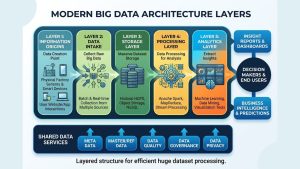
The structure and design used to gather, store, and analyze enormous datasets is referred to as data architecture. There are various layers in a typical data architecture:
- Information origins: This is the starting point where all data is created. This includes everything from physical sensor in factories and smart devices to user interactions on website and mobile apps.
- Data Intake: Systems collect large amounts of raw big data from many sources.
- Storage Layer – Platforms such as big data Hadoop store massive datasets.
- Processing Layer – Technologies process data for analysis.
- Analytics Layer – Tools perform big data analytics to extract insights.
This layered structure helps organizations process huge datasets efficiently.
Map Reduce
Map reduce is one of the key technologies utilized in data Hadoop. There is a programming paradigm known as MapReduce that divides the tasks into smaller pieces so that it can process big data. The steps involved are:
- Map Phase: The system divides data into smaller pieces and processes them independently.
- Reduce Phase: After processing, these pieces of data are combined to form insights.
This process is helpful because map reduce is used to process data, and companies dealing with data analytics use this method.
Importance of Analytics
The main function of big data analytics is that it converts raw data into insight that helps organization to analyse data.
What is big data analytics
The process of analyzing large amounts of datasets to find patterns, trends, and connections is called data analytics.
Data analytics are used by organizations to:
- Predict customer behavior
- Enhance your marketing tactics
- Detect fraud
- Optimize operations
- Improve client satisfaction
E-commerce businesses, for example use big data analytics to make product recommendations.
Big Data Growth in India
The data industry is growing rapidly in India. Many sectors now depend on data analytics.
Industries using big data include:
- Banking and financial services
- Healthcare
- E-commerce
- Telecommunications
- Transportation
Government initiatives like digital transformation programs also increase demand for data architecture and big data Hadoop systems.
Because of this growth, careers in big data analytics are becoming highly valuable.
Advanced and Specialized Concepts
Other than the basics, data ecosystems are supported by a number of cutting-edge technologies.
Processing in Real Time
Traditional systems process data in batches. But real-time analytics processes information instantly. Technologies like streaming platforms enable organizations to react quickly to changing data.
Examples include:
- Fraud detection systems
- Real-time traffic monitoring
- Online recommendation engines
Cloud-Based Architecture
Data Architecture has changed because of cloud computing. These days, businesses use cloud platforms to store large amount of data without worrying about maintaining physical servers.
These are some advantages:
- Flexible storage capacity
- Lower infrastructure costs
- Faster deployment
- Improved scalability
Many organizations in India now combine cloud systems with Hadoop for efficient processing.
Big Data and AI
Analytics and artificial intelligence are compatible with each other. For AI models to identify patterns, large datasets are needed. It provides the training data needed for machine learning algorithms.
Applications include:
- Voice assistants
- Recommendation systems
- Smart healthcare diagnostics
- Predictive analytics
This integration makes architecture even more powerful.
Last Words: Why Understanding what is Big data Important
Big data is becoming increasingly significant as digital systems produce more and more information each day.
It helps organizations in unlocking powerful insights using big data technology and understanding how this industry works—its secret is big data, Hadoop, or map-reduce big data.
Day by day big data analytics is becoming more needed for businesses in India to serve better, forecast trends, and gain an edge on competitors.
The important question is: How will your organization use big data to make better decisions in future?